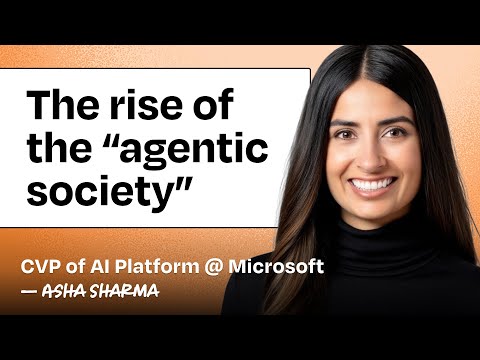
80,000 家公司如何用 AI 构建:产品即有机体与组织架构图的消亡 | Asha Sharma
80,000 家公司如何用 AI 构建:产品即有机体与组织架构图的消亡 | Asha Sharma
逐字稿
开场
Lenny Rachitsky: 他说我们才刚刚触及智能体(agent)社会真正面貌的表层。
Asha Sharma: 我们正在逼近这样一个世界——优质产出的边际成本趋近于零。我们将看到对生产力和产出的指数级需求,而应对这种规模扩展的方式就是通过智能体。当这一切发生时,组织架构图就开始变成工作图,你不再需要那么多层级了。
Lenny Rachitsky: 我们之前聊过你提出的一个概念——我们正在从”产品即人工制品”转向”产品即有机体”。
Asha Sharma: 因为这些模型目前已经如此高效,你会想开始将它们调优到特定类型的结果上。突然之间,这些产品变成了活生生的有机体,随着交互次数的增加而不断变好。我认为这是每家公司全新的知识产权——能够思考、生存和学习的产品。
Lenny Rachitsky: 眼下的规划简直疯狂。在”GPT-5 出了”这种情况下,任何人怎么规划路线图?
Asha Sharma: 我们把它想成我们处在哪个”季”。第一季可能是 AI 的原型开发阶段,然后一切都围绕模型和推理模型展开,现在则是智能体的兴起。
嘉宾介绍
Lenny Rachitsky: 今天我的嘉宾是 Asha Sharma。Asha 是微软 AI 平台的首席产品副总裁,负责 AI 基础设施、基础模型和智能体工具链,同时领导核心 AI 部门的应用工程、负责任 AI 和增长业务。她此前曾任 Instacart 的首席运营官和 Meta 的产品副总裁,负责 Messenger、Instagram Direct、Messenger Kids 和 Remote Presence。她还是 Home Depot 和 Coupang 的董事会成员,同时是跆拳道黑带二段。
Asha 拥有一个非常独特且罕见的职位,这使她能够比世界上几乎任何人都更清楚地看到 AI 的发展方向,以及对于构建大规模 AI 产品的公司来说什么有效、什么无效。在我们的对话中,Asha 分享了她观察到的一系列趋势和预测,其中很多是我没有听其他人谈论过的:为什么我们正在从”产品即人工制品”走向”产品即有机体”的世界,为什么 GUI 正在被代码原生界面所取代,为什么后训练(post-training)是新的预训练(pre-training),即将到来的智能体社会时代,今天以及未来成为一名成功的构建者需要什么,以及她从密切合作的 Satya 身上学到的最重要的领导力一课。
接下来,有请 Asha Sharma。
Lenny Rachitsky: Asha,非常感谢你来参加播客,欢迎来到节目。
Asha Sharma: 谢谢邀请。
产品即有机体
Lenny Rachitsky: 我想从我们之前聊到的一个概念开始,这个概念我从未听说过,但我认为对人们的思考会非常有帮助——就是你提出的我们正在从”产品即人工制品”转向”产品即有机体”。谈谈这意味着什么,人们需要理解些什么。
Asha Sharma: 这是一个相当有趣的变化,尤其是过去一年左右。当我加入微软时,正值 OpenAI 和大型基础模型出现之后,紧接着就出现了模型的爆发——专有的和开放的前沿模型(frontier model)不断推进前沿曲线,它们既更高效,又开始在不少模型中展现出领域级的专业能力。而更近期,模型现在可以进行工具调用和函数调用,可以采取行动了。我认为这正在催生一类开始取得成功的新型产品。
突然之间,产品不再只是我们发布的那些静态的人工制品——不再只是”嘿,想出一个点子或洞察,去解决一个问题,把它发布到世界上,也许再稍微改进一下,然后加个仪表盘”。整个核心指标变成了:一个产品团队消化数据、消化奖励模型(rewards model)、然后创造某种结果的新陈代谢速度有多快?因为这些模型目前已经如此高效,你会想开始将它们调优到特定类型的结果上,无论是价格、性能还是质量。所以这相当令人兴奋,因为突然之间,这些产品变成了活生生的有机体,随着交互次数的增加而不断变好。在许多方面,我认为这是每家公司全新的知识产权,这是一种完全不同的产品构建方式,甚至是一种全新的方式来思考那些能够思考、生存和学习的产品,这确实令人兴奋。
数据护城河与后训练的兴起
Lenny Rachitsky: 听到这里,我想到的是我之前请 Cursor 的 CEO Michael Truell 上播客时,他大量谈到他们最大的护城河是从人们使用 Cursor 的过程中捕获的数据——接受某些建议,不接受其他建议。这是你在这里说的意思吗?就是公司从人们使用产品中收集的专有数据,还是说有更深层的东西?
Asha Sharma: 我认为我们之所以看到后训练的兴起,正是因为模型本身已经如此强大。截至今年,Nathan Lambert 做了一项我觉得相当有趣的研究,分析了所有顶级排行榜,结果显示一旦模型达到 300 亿参数,实际训练一个模型并投入数十亿 token 进行预运行的资金支出在经济上就不再合理,而你可以开始在循环上进行优化。所以在许多方面,我认为使用你自己的数据是最佳的优化方式,但你也可以合成生成数据。
你需要设计奖励机制,需要真正地部署上线,需要严谨地进行 A/B 测试。你需要找到最合适的应用场景或用例。然后是的,这会产生你可以从中学习的数据。我从没见过任何产品只有一个反馈循环。我认为那是多条轨道并行运行,就像流水线一样,不断产出结果。
Lenny Rachitsky: 那么这个论点——我们正在走向”产品即有机体”——基本上只适用于模型公司,还是说也同样适用于,比如说,SaaS 企业、工具类产品和用户工具?
Asha Sharma: 你看,我认为软件作为一种基础构件正在发生变化,其内部的核心产物是模型,与软件组件并存。所以在很多方面,我认为软件产品都将成为”模型驱动”的产品。
Lenny Rachitsky: 这让我想起我之前请 ChatGPT 的负责人 Nick Turley 上播客——就是我们录音前聊到的那个——我当时问他 ChatGPT 会随着 GPT-5 的推出有多大变化,他就说,“是一样的,它们是同一个产品。只不过是模型告诉我们在 ChatGPT 这个产品中该做什么。”
这让我联想到另一件事——你可能会想,为什么 GPT-5 不能直接自己构建用户界面,就像你使用它的过程中,它自己就在进化。这差不多就是它在 Canvas 和其他功能上正在做的事情。但这是我在理解你说的”产品即有机体”这个概念时的另一个角度:产品的 UX 可以根据你的使用方式而变化,自动进化,而不需要产品团队去做任何事情。
Asha Sharma: 我百分之百相信世界正在朝这个方向发展,而且我的体验看起来会和你的不一样。我一直在做个性化相关的工作,但在未来你可以实时地实现这一点。所以我认为那会是一个相当有趣的世界。我也认为对于智能体来说体验会不同,对于高级用户和新用户来说也会不同,所有这些都会有差异。
成功 AI 产品的组织模式
Lenny Rachitsky: 让我拉远一点问你一个问题。你们和很多公司在你们的平台和其他平台上构建 AI 产品。我猜有些做得非常出色,势如破竹,有些则在挣扎。你发现那些真正成功、做出了非常成功的 AI 产品的公司有哪些共同模式?做得不好的公司又有哪些问题?
Asha Sharma: 是的,我觉得有些东西更广泛地适用于组织本身,还有些东西则适用于那些构建 AI 产品的人。从更广泛的角度来看,我认为成功公司开始呈现出一种模式。第一,他们拥抱 AI,每个人都变得 AI 熟练。
所以我认为每个人都在日常工作中使用某种副驾驶或 AI 工具,这是第一位的,这样每个人都对它不感到恐惧,理解它如何为各种技能和任务提升上限、降低门槛。第二,在此基础上,他们开始说,“好的,我怎样才能对一个已有流程应用 AI 使其变得更好?“这可能是客服支持之类的事情,或者是将欺诈处理的解决时间从 15 天缩短到 10 天。
在完成整个循环——梳理流程、应用 AI、看到某种影响,然后感受到利润表的收益或内在价值——之后。第三件事就是,“好的,很好。现在你看到了影响,每个人都在使用它,你如何真正用它来推动增长?“这可能是改善客户体验,从而提升客户终身价值或留存率。也可能是共创一套新的概念或品类。
也可能是从嵌入式智能体发展到具身智能体,然后能够承担指数级增长的任务量。我认为公司失败的原因是他们为了 AI 而 AI。他们同时启动大量项目,却没有一个蓝图来理解它到底是怎么运作的、他们的技术栈长什么样,而且他们没有把它当作一个真正的投资来对待,所以他们没有建立好测量、可观测性和评估体系。
这是需要端到端去做的。我认为对企业来说棘手的是技术在不断变化。去年 AI 领域推出了大约七万种企业工具。真的很难知道为了什么目标应该选择哪个工具。所以你真的需要押注一个平台或某种应用服务器类型的层,让你可以灵活地替换各种组件,而不是被任何一项技术或工具所绑定,因为现实是整个局面都会变化。
我觉得你必须为发展的斜率而不是当前的快照来构建。所以这大致就是我在企业层面看到的。我认为构建者本身也在发生根本性的变化。每一次重大技术变革都会带来角色的变化——从大型机到 PC,诞生了整个车库工程师文化,然后当我们从服务器走向云和移动端时,出现了 SEO 专家、CDN、增长负责人、UX 研究员、前端、后端等等。
而现在我认为我们正在见证”通才型”构建者的兴起,全栈构建者正在迎来他们的复兴。如果你看一个普通组织,推出一个产品大概需要十个步骤。可能是安全评审、规格文档、用户研究,然后涉及多少个职能?五个以上,可能六七个。我对一般组织算是比较宽容了,然后你有六七个层级。所以突然之间,你有 500 个不同的接触点需要完成才能推出一个产品,而当每周有 500 个新模型或 500 项新技术出现时,这远远不够。
所以我非常相信全栈构建者的概念。你可以在很多新兴的 AI 原生公司中看到这一点。我甚至在那些有 50 年历史的企业中也开始看到他们以这种方式运作。我认为这给了你速度和产出,然后让你能够完成整个循环,更快地消化和迭代。
Lenny Rachitsky: 这确实是这些对话中反复出现的主题——PM、工程、设计的韦恩图正在收敛,而且越来越多其他职能也在融入你的角色。所以 PM 需要在设计或工程上提升自己。
Asha Sharma: 是的,我完全同意。我认为这里的关键是循环,而不是车道。所以不管你是什么职能,你都必须痴迷于去理解产品的效率或成本、你真正追求的奖励或系统设计、实际的 UI、UX,这些东西如何真正为智能体或人呈现出来。你必须非常快地在这方面变得非常擅长。
Lenny Rachitsky: 我喜欢你刚才用的这个说法——“循环而不是车道”。能再多说说吗?
Asha Sharma: 哦,就是回到我们之前讨论的信号循环,产品在进化,变成这些活的有机体,而不是静态的产物。如果你把真正做好这个循环作为目标,我认为那就是产品本身,那就是 IP,那就是每个组织的未来。我认为反馈会变成持续的,可观测性会变成文化,我认为职能会在未来的工作团队中开始模糊。
Lenny Rachitsky: 为了让这更具体,有没有一个产品或公司的例子,是很好地践行了这种做法、过着这种循环式生活的?
产品实践中的数据飞轮
Asha Sharma: 我认为从 AI 视角来看,我们观察到这个领域的大多数公司都在这样做。我可以举几个我们在合作的例子。在编码领域,你提到了 Cursor。GitHub 有非常类似的功能,我们使用了一个由多个模型组成的集成,这些模型在 30 个不同的国家、所有语言上进行了微调,然后在一个循环中不断迭代,以提供下一轮建议、代码补全等等。
我们有一个面向医生的 AI 产品叫 Dragon,我们看到一个巨大的差异——当我们使用合成微调时,与后来由专家标注了 60 万次医患互动、并将这些数据输入模型持续优化之后的效果相比,字符接受率从原来的 30% 到 60% 之间(取决于具体运行情况)提升到了大约 83%。这只需要一小群人,而不是一个庞大的组织,他们能够跨职能地在这个循环中不断迭代,所有那些界限都在消融。
Lenny Rachitsky: 这太有意思了。所以我听到的是,如果你能收集运行效果的数据,然后花大量时间创建高质量的标注来反馈、微调,这基本上就是最大的优势——也是你在这些领域获胜的关键。好,沿着这条线,你还跟我提到过另一个你注意到的趋势,我想多听一些,就是从 GUI 到代码原生界面的转变。你说说这意味着什么,长什么样,对做产品的人意味着什么。
从 GUI 到代码原生界面
Asha Sharma: 我觉得这归根结底是未来做产品的人意味着什么。我认为所有人的第一直觉都是 GUI,但如果你回溯历史,数据库从桌面端下沉到了 SQL,云时代全是控制台,现在则是 Terraform。所以我认为我们正在看到历史上已经上演过的同样模式,开始在 AI 和其他一切领域重演——就像摩尔定律一样,而且越来越快。这个趋势正在加速。而且你想想,文本流与 LLM 的连接更加自然。
所以我认为有诸多趋势共同推动着未来产品走向可组合性,而非画布。我认为产品创造者真的需要重塑自己的思维方式,因为我们花了大量时间去思考某个东西的 UI,而不是它如何组合、一个智能体如何读取它、如何真正实现无限扩展、协作如何开始运作。所以我认为这只是一种新的思维方式,尽管这个趋势在这些变革中由来已久。
Lenny Rachitsky: 那么这里的预测是,未来会是像 Claude Code 那样的终端式体验,还是由智能体来接管,还是两者兼有?你刚才说的就是这个意思吗?
Asha Sharma: 对,说真的,如果我们任何一个人能确知答案那就太好了。我只是认为终端之所以好用、在编码时感觉那么好,是因为它与 LLM 通过文本流交互的方式。我认为两者可以并存——人类会继续提交代码,也会找到新的方式来做这件事,不管是在 IDE 里、在 GitHub Copilot 里,还是在某种新的开发环境中;同时我认为我们也会与智能体一起做这件事,智能体之间也会相互协作,并从这里继续演化。
Lenny Rachitsky: 我们之前请过 Sierra 的创始人 Bret Taylor 来做播客,他有一个类似的预测:所有软件公司都会变成智能体公司。你在这里说的本质上也是一样的——软件会变成一个在后台运行的东西,GUI 会大幅减少。那你觉得会不会变成我们正在习惯的这种聊天界面?它会成为与智能体交互的主要界面吗,还是会有别的什么?
Asha Sharma: 我认为对话是一个非常强大的界面。我做过消息相关的产品,我认为它在很多沟通形式中都很棒,但它不是唯一的沟通形式。我们今天用邮件相互协作,我们用文档,大家都用 Word 和 PowerPoint。有十亿人生活在各种文档制品中,我认为这些都可以成为画面中非常重要的可组合的部分,也理应如此。所以我对这一点很期待。聊天会很重要,但肯定是不够的。
Lenny Rachitsky: 有意思的是,ChatGPT 是有史以来增长最快的产品,可能也是有史以来最具影响力的产品——它就是聊天。
Asha Sharma: 对,它很棒。
Lenny Rachitsky: 它管用。
Asha Sharma: 我觉得我们需要问自己的问题是,它会不会永远只是聊天?
Lenny Rachitsky: 对,对。Nick 的描述方式是,我们正处在 ChatGPT 的 MS-DOS 时代,这很有意思。这跟你说的恰好反过来——也许是先从聊天开始,然后必须走向 GUI,然后也许再回去。但他说会有一个”Windows 版本”,让你更容易搞清楚到底发生了什么。
Asha Sharma: 对。我认为这个想法很聪明。每家公司都应该把 AI 带到用户所在的地方,而 ChatGPT 的所有用户都在用聊天,它是一个出色的产品。而全球有很多人以各种不同的方式工作,我们应该思考如何用 AI 来赋能这些方式。
智能体社会
Lenny Rachitsky: 那我们来聊聊智能体吧。你花了很多时间与智能体打交道,构建智能体,帮助企业构建智能体。你有一句话我特别喜欢,你说我们才刚刚开始触及智能体社会真正面貌的表层。我太喜欢”智能体社会”这个概念了。未来它到底会是什么样子?
Asha Sharma: 天哪。说来有趣,你之前跟我聊到你两岁的孩子,我儿子 Ron 刚满一岁,我都无法想象两岁是什么样子——觉得那好遥远,届时又会发展出什么来。我认为在未来,工作看起来会非常不同。我们正在走向这样一个世界——优质产出的边际成本趋近于零。而当这种情况发生时,我们将看到对生产力和产出的指数级需求。
而我认为实现这种规模化要靠智能体——嵌入式的智能体,以及它们的工具和软件。我认为这类东西会比我们今天使用的软件多得多。然后我认为还会出现一批具身智能体,我们现在已经开始看到了,对吧?你可以把一个 pull request 分配给 Copilot。你可以创建一个智能体式的软件开发代表,帮你做线索挖掘和开发。
所以我认为当这一切发生时,组织架构图开始真正变成工作图。我认为任务和吞吐量会变得比以往更重要。我也认为你不再需要那么多层级。整个组织架构可能在几年内就会开始呈现出不同的面貌,所以我对此很期待。会议还是会是会议,还是会有些怪,但我觉得会好一些,会有很多变化。
普通员工的技能扩展
Asha Sharma: 我觉得对于普通员工来说,我的期望和我乐观的看法是,他们能够扩展自己的技能组合,因为现在他们有了自己的智能体栈,可以带到工作中,就像你可以自带设备一样,你可以开始接触到以前从未有过的一整套技能。所以如果你想一下,全美大约有两千万人处于这个领域,如果他们的技能提升 20%,对 GDP 的影响是相当指数级的,所以这是很有趣的事情。
Lenny Rachitsky: 你提到的”工作图取代组织架构图”这个说法是个非常深刻的概念,因为我不确定你是不是这个意思,但我脑海中的画面是——你组建这些团队,给他们使命、目标和 KPI,成员包括人类,然后说”好,先去做这件事”。而我在听你说的过程中意识到的是,如果你让智能体来做这件事,那它们的提示词就是”去提升转化率”。然后你有一大堆智能体,那就是组织本身。这就是转化引导团队,就是一群智能体在外面各自干活。你说的就是这个意思吗?
Asha Sharma: 对,我觉得今天我们的思维方式是,“组织架构图中谁向谁汇报,谁负责哪些领域”。而我觉得归根结底,当你拥有一组有能力的智能体,人们能胜任更多事情的时候,你就不会再用层级制来思考,也不会再按照向上沟通的方式去运作,而是开始转向基于任务的、向外拓展的机会。我认为在组织中,人类将始终决定 AI 如何使用、我们想把它应用在什么地方。
但当一个新的问题或新的任务出现时,你如何自动决定把它分配到哪里?谁在处理那个任务?如何实际去执行?如何观察它是否在做正确的事?如果做得不对,如何微调?所有这些事情都变得令人兴奋。所以我在推测,存在这样一种可能性——那将是非常激动人心的,我觉得这很好,因为我们能完成更多事情。
审核智能体工作的挑战
Lenny Rachitsky: 你提到了审核工作变得越来越重要这个观点。如果你有一千个智能体在外面干活,那真的是——天哪,要审阅的东西太多了,要确保它们做的是正确的事。你认为这件事会如何演进?就是扩大你审核正在进行的工作的能力?
Asha Sharma: 对,我觉得我们之前讨论过的那种循环变得越来越重要了——微调和自修复的可观测性、非常好的评估,所有这些都缺一不可。好消息是,目前已经存在为数十亿人管理这类事务的系统,所以我觉得我们不必重新发明轮子。当然,如果那种场景真的出现,肯定会有很多新的东西需要学习,但管理设备、策略和组权限这些事情都是已经解决的问题,这是好事。
~ (广告段落已跳过) ~
团队中智能体的实际应用
Lenny Rachitsky: 这一切感觉很多都还在未来。我知道其中很多东西已经在发生了,人们正在以各种不同方式使用智能体。你和你的团队有没有发现与智能体协作的某种特别有价值的方式?除了编码之外——我想编码肯定是很大一部分——但有没有什么让你觉得”哇,这真的是件大事”的?
Asha Sharma: 到目前为止,我们已经在很多工作流程中融入了 AI 和智能体。我最喜欢的一个场景是——现在我的工程搭档们都不在,所以我直接跳上现场的故障排查桥接通话。当出问题时,简单到你可以自动获得刚才所有事情的摘要,因为通常有十五个人在同时讨论,你其实不知道事故从哪里开始的、会走向哪里,然后突然间我就有了这些信息,可以弄清楚状况、提问、获取最新进展。非常棒。我觉得整个 DevOps 领域都在发生变化。
我们用 Spark 来创建原型,所以团队里的每个人都要求会写代码,但有时候直接用自然语言聊一聊、说一说,反而能得到一个更有趣、更能反映你创造力的原型。所以我们也在用这个。我觉得大家都在用 AI 来写作,都在用 AI 来提升效率、撰写文档等等。所以我觉得它无处不在,这很酷。不过我认为在智能体协作方面,我们还只是触及了皮毛。
Lenny Rachitsky: 这就是每次有人问我怎么用 AI 时的感觉——就是无处不在。它渗透到我做的每一件小事里,我甚至不知道该怎么描述。
Asha Sharma: 对,已经很难回忆起一个它还不存在的世界了。
Lenny Rachitsky: 对,有一个和我合作的的产品经理 Peter Yang,他就说他”甚至不知道没有 AI 的情况下怎么做战略文档了。以前的人没有这个辅助是怎么做的——”
Asha Sharma: 你觉得未来还会有战略文档吗?这会很有意思。
战略制定与人类判断
Lenny Rachitsky: 我曾经写过一篇文章,讨论产品经理工作中哪些技能最容易被 AI 取代,其中战略是人们争论最激烈的部分。你可以说——我也不知道,我们简单聊聊——你可能会想,如果某个 AI 拥有你掌握的关于市场走向、你的指标、你当前产品的所有信息,它应该能非常擅长为你制定战略。但很多人认为这是 AI 长期内最不擅长的领域,因为这正是需要人类判断力的地方。你有什么看法?
Asha Sharma: 我认为世界上一些最具影响力的产品,需要大量确定性的、逻辑性的输入,同时也需要创造力、想象力、判断力和远见的火花,这些东西离开了人类是无法实现的。微软关于软件工厂的愿景以及它所创造的一切,并非必然发生的。Instacart 也是如此——之前有 WebVan,WebVan 失败了,但 Instacart 成功了,因为一种不同的思维方式。那是在实际经历过程中才能获得的——通过迭代和一系列经历,iPod 也是如此。所以我觉得人类的这些能力是存在的。而文档本身,对于每一个想法、每一个需求,会逐渐消融为应用程序和生产力套件中不同的制品,这只是一种不同的工作方式。
组织协同的新机制
Lenny Rachitsky: 对,你最初的问题我还没有完全回答,但我觉得很重要。你问的是我们是否还需要战略文档?我想,无论如何每个人都需要对战略达成共识,只不过它可能不再是一份文档。
Asha Sharma: 没错。
Lenny Rachitsky: 对,它可能是某种其他形式的制品。
Asha Sharma: 如果你以正确的方式设计一个组织来跟上 AI 的步伐,你需要不同于传统工作方式的协同机制。
路线图与规划
Lenny Rachitsky: 那我正好问问你这个。现在的规划简直疯了。当”GPT-5 发布了”这种事情随时可能发生,大家怎么规划路线图?什么方法对你制定团队的实际路线图和战略有效?你会规划多远?多久需要重新推翻一切?
Asha Sharma: 我先说一句,大家其实都在摸索。而且组织越大,摸索起来就越难,不像规模小的时候可以自己亲自操盘——两者各有优劣。我们的做法是这样的。公司历史上,至少在产品团队中,是按”学期”来做规划的。你可以理解为每六个月做一次战略回顾,回顾过去、展望未来,诸如此类。我觉得这很有价值。但六个月这个周期,要真正理解前方正在发生什么变化,确实很有挑战性,容易导致过度规划。所以我们的思路是:我们处于什么”季节”?一个”季节”——这个说法让人不太舒服——可以由行业中正在发生的一系列结构性变化来定义,或者是客户侧正在发生的变化。
你可以想象,第一个季节可能是 AI 的原型开发和早期的 GPT 工作,然后是围绕模型和推理模型的阶段,现在则是智能体的兴起。这个季节可能持续一年,可能六个月,也可能三个月。但关键是让每个人都对以下问题有共同认知:结构性变化是什么?我们需要解决客户什么问题?赢的标准是什么?这样大家就有了一致的共识。我们会设定一个北极星指标,这是我们的做法。第二件事是,我们有比较宽松的季度 OKR。比如,“如果我们认同这个方向,那下个季度我们需要做什么才能真正走上那条路?“然后从这个层面出发,团队以小组(squad)为单位运作,设定四到六周的目标,针对特定问题领域去推进,逐步向上对齐。尤其是作为公司的平台以及面向 Azure 客户的 AI 平台,说实话我们一直在经历大量的变化,我认为我们必须接受一个事实——这就是我们所处的行业性质。
还有一点,我们尽量在系统中留出余量(slack),不仅是为了应对计划外的事情,也是为了留出提升的空间。我认为我们必须持续思考如何用我们的思维来颠覆现有平台,以及需要投资什么来让这一切成为可能。所以我们努力在这两方面都做一些兼顾。
Lenny Rachitsky: 这太棒了。所以我听到的是,有一个”季节”的概念,所有人都达成共识:“好的,现在是智能体的时代,这是当下正在发生的事情。我们的战略要围绕智能体来展开。“然后有比较宽松的季度 OKR,大概规划三个月,再在系统中留一些余量来应对变化。
Asha Sharma: 是的。
当前季节:智能体的崛起
Lenny Rachitsky: 当前的季节就是智能体吗?你怎么描述我们现在处于什么季节?
Asha Sharma: 对,就是智能体。智能体的崛起。
Lenny Rachitsky: 智能体的崛起。听起来像《终结者》电影。你有感觉下一个季节可能是什么吗?有没有什么”哦,接下来可能是这个”的想法?
Asha Sharma: 天哪,我没有。但我想说,目前在我们的服务上——至少在 Azure 服务上——已经部署了超过 15,000 个智能体。公司内部还有很多其他平台。我的看法是,我们应该真正专注于确保我们拥有所有必要的对齐机制、问责机制、可观测性、评估能力,让这些智能体变得出色。
我认为 Manus 在这个领域的突破在于,他们能够实现这些工具调用循环,让智能体执行长时间运行的任务,这是其他平台做不到的。我觉得这类进展至关重要。记忆能力也至关重要。仍然有一些建筑模块的缺失,导致智能体在实际应用中不够完整,我认为在转向下一个阶段之前,我们需要在这些细节上狠下功夫。
Lenny Rachitsky: 所以就是一直做智能体,直到时间的尽头,直到超级智能出现,然后我们就躺在海滩上享受了。
Asha Sharma: 对,智能体一直做到”废梗”横行。不过我觉得很酷的一点是,新的东西可能在三个月后出现,也可能在十三个月后出现。我们对一组建筑模块有坚定的信念,我们想提供这些模块来让这些智能体具有持久性和高耐久性,这就是我们聚焦的方向。
Lenny Rachitsky: 你说有 15,000 个智能体,这是什么意思?是 15,000 种可用的智能体类型,还是有 15,000 个正在运行的流程?
Asha Sharma: 不是,那是客户数。15,000——我想我应该重新确认一下这个数字——15,000 个已经构建了智能体的客户。实际的智能体数量应该是数以百万计的。
Lenny Rachitsky: 15,000 个客户在你的平台上构建了特定类型的智能体,它们正在运行,而智能体的数量是以百万计的,就在云端运行着。
Asha Sharma: 是的,完全正确。
Lenny Rachitsky: 好的。这些数字太疯狂了。好,让我稍微换个方向。你处在 AI 风暴的中心,看到了所有正在发生的事情。有没有什么是你在这个角色之前希望自己就知道的?就是那种”好的,我明白了,但我之前没预料到这个”的东西。
角色中的意外发现
Asha Sharma: 我刚接手这个角色的时候,有人把它描述为”兽腹之中”(belly of the beast)。我的职业生涯大部分时间都在构建以机器学习和应用或业务为中心的产品。出乎我意料的是,很多经验其实是可以迁移的——打造一个伟大平台所需的东西,和打造一个伟大产品所需的东西是相通的。而对我来说,真正驱动这一切的,往往是那些看不见的工作,而不是那些可见的像素。
举个例子,我早期工作过的一家公司叫 Porch Group。我是第七号员工。我们当时的目标是帮助人们打理自己的家。我们发明了很多功能,比如”房屋报告”、一种管理房屋的方式、房屋风格灵感——你可以看到所有的房子,它能把每个房间都做成地图。但在我任职期间,我们能做的、也确实做的最重要的一件事,是创建了一个匹配平台——将 600 万专业人士、1,300 种服务类型、37,000 个邮政编码与北美所有房主进行匹配,从而真正帮助人们打理自己的家。这本质上就是一场寸土必争的较量(game of inches),不断优化那个引擎,以此来生成更高质量的线索。
平台制胜的核心要素
Asha Sharma: 正是这些让我们达到了第一个五亿美元估值。后来我们在此基础上进一步构建了其他垂直服务和软件平台,这些成为了公司的知识产权。做消息产品也是同样的道理。我最大的一个领悟是——WhatsApp 并不是因为贴纸、Stories 或深色模式而赢的。事实上,它赢的时候甚至可能连这些功能都没有。它之所以赢,基于几个前提:第一是通讯录——你知道使用 WhatsApp 时可以联系到每一个人,因为你有他们的电话号码,而这些正是你在使用消息应用时想要联系的人。
第二是可靠性和速度。我可以给在印度的祖母发消息,确信她每次都能收到。然后是隐私。当你每天给你最在乎的四个人发送两百条消息时,你要确保没有其他人能读到这些消息,所以端到端加密至关重要。所以,决定胜负的不是几百个功能,而是基础设施和平台本身。
Instacart 也是一样。Instacart 有很多深受用户喜爱的功能,但归根结底,它是靠十亿件商品、每分钟更新三千次的数据,把房主们需要的日用品从他们喜欢的商店送到家门口。所以我希望我早点认识到这一点,因为这会大大缩短我的学习曲线——平台获胜靠的不是所有那些功能,而是数据驻留能力。
也就是说,德国的医院在微调模型时可以放心去做,数据不会离开所在地区;还有可用性、可靠性。确保企业所需的工具选择正确,知识检索方式正确。这就是我们搭建的平台,只是当初并没有完全意识到这些经验会迁移过来。
Lenny Rachitsky: 嗯,这很有意思。我听到的是,人们往往低估了那些最基础的东西——就像马斯洛需求层次金字塔的最底层——那些真正帮助平台获胜的因素,尤其是在消息平台中,比如可靠性、隐私、可用性这些。
Asha Sharma: 对,性能、可靠性、隐私、安全性,所有这些东西。
与 Satya 共事中学到的领导力
Lenny Rachitsky: 换个完全不同的话题。之前我们约录制的时候,你说”我有个跟 Satya 的重要会议要做”,所以我们改了时间。很少有人有机会和 Satya 共事,他是一位非常成功的领导者。你从他身上学到了什么?关于领导力或产品打造方面的?
Asha Sharma: 我学到的是,乐观是一种可再生资源。这家公司五十年来有无数理由可以不成功,但它在 AI 时代取得了早期成功,也经历过挑战和其他成功,而这个领域发展得如此之快。我认为他激发能量、用乐观去更新每个人对使命的投入,这种能力令人难以置信,而且我认为这是公司文化中极其重要的一部分。每个人都在谈论成长型思维,这是真实的,是文化中非常重要的一部分。但我认为,在一个竞争极其激烈的人才市场中,能够激发能量、清晰传达我们需要做什么、用乐观来每天更新每一个人对使命的承诺——这种能力是非常了不起的。
Lenny Rachitsky: 你觉得这是他天生的,还是他后天刻意培养的——为所有人持续生成这种乐观的能力?
Asha Sharma: 我不知道。这个问题应该问他,但我对此深感钦佩。
Lenny Rachitsky: 有意思的是,很多东西归根结底就是一种”氛围”(vibes)。不仅仅是他说的话,而是他散发出来的那种乐观和能量。
Asha Sharma: 想想看。我们每个人每天都在选择关上孩子房间的门,去做一份工作。所以你必须做一件让你深受触动的事,你必须深信它会让世界变得更好。我觉得这就是为什么说是”氛围”。你必须追随并忠于一个比自己更大的使命。
Lenny Rachitsky: 这让我想到我在播客中引用过好几次、每次都让人深受触动的一句话——唯一会记住你加班到深夜的人,是你的孩子。
Asha Sharma: 好吧。我不知道这话要往哪儿走,但现在……嗯。
Lenny Rachitsky: 太沉重了。扯太远了。天哪。好吧,让我换个问题。驱动你的是什么?
Asha Sharma: 我们本可以说”客户”,可以换一种方式回答的。
AI 与人类的未来
Lenny Rachitsky: 这才是真话。驱动你的是什么?是什么让你对现在做的工作保持兴奋?
Asha Sharma: AI 在劳动力方面将帮助我们做到的事,在医疗健康方面将帮助我们做到的事。我妈妈患有癌症,我经常想,我们是否能在我的有生之年找到治疗她那种癌症的方法——三年前我从未觉得这是可能的。所有这些都意义深远。而既然我们生活在这样一个时代,与如此强大的技术共事,我个人现在反复思考的是这项技术的影响,以及我怎样才能最好地构建一个平台,让人们能够善用它。
所以我选择在微软工作,是因为这家公司的整体理念就是如何帮助个人和企业成就更多。对我个人来说,除了 GPU 之外,我晚上躺在床上想的是:我儿子将来还会有同班同学吗?这不是因为智能体会取代他们,而是因为生育率在下降。我们成长的九十年代,平均生育率大约是三,现在是 2.3,预计到 2050 年将低于更替水平。我认为 AI 可以对此产生巨大影响,而且已经在产生了。
我刚读到伦敦一家医院利用 AI 匹配卵子和精子来提高怀孕率,同时还在降低成本。你也看到了昨天 ChatGPT-5 的发布,其中有一个很棒的故事是 ChatGPT 如何在医疗健康领域发挥作用。斯坦福是我们的重要客户,使用我构建的平台,他们正在用 AI 做肿瘤评审。就是这些事情将推动人类向前迈进,延长我们的寿命,让我们有幸去解决百年级别的问题。这就是我为什么兴奋,这就是我做这些事的原因。
Lenny Rachitsky: 是的,尤其是你现在的角色,你在构建的是支撑这一切的平台,我能理解这有多大影响力。Asha,在我们进入非常精彩的闪电问答之前,还有什么想补充的,或者想在前面聊过的内容上再展开的吗?
Asha Sharma: 我们简单提到过,但我认为随着智能体的出现,以及能够思考、行动和推理的产品的出现,将会出现一波围绕 RL 的新浪潮。我深信,这将变成下一个阶段——至少接下来几个阶段中——最重要的产品技术之一。
Lenny Rachitsky: RL 是指强化学习(reinforcement learning)吗?
Asha Sharma: 是的,没错。我相信未来花在后训练上的资金将与预训练相当,甚至更多。我们之前简单提到过 Nathan Lambert 的研究,他的观点是当一个模型达到 300 亿参数时,进行微调更有意义;而且调查显示 50% 的开发者现在都在做微调。我们知道微调是有效的,但如果你真正走完整个闭环,效果会更好。
所以我觉得这里面有很多机会,而且围绕这一层技术栈,将会涌现出全新一批基础设施、平台和公司。因此,我觉得现在是做平台的好时机,同时也是创业和思考这些问题的好时机。
Lenny Rachitsky: 我想确保大家真正理解你在这里说的,因为不是每个人都真正理解后训练和预训练的区别。用最简单的方式来理解这两者的差异是什么?为什么投资重心向后训练转移是件大事?
Asha Sharma: 我的理解是,创建一个基础模型需要大量的计算资源、大量的科学研究,以及我们看到的——科学家的成本或者说平均价值正在急剧上升——而且我们看到的专业知识并不是全世界到处都有的。所以这是一笔巨大的资本支出投资。
我们之前聊过,随着模型的爆发式增长,针对不同领域已经有了很多好的模型可供选择。因此我认为,从经济角度来看你能获得更大的杠杆,从品味的角度来看——你实际上想如何引导模型——如果你通过强化学习或某种微调来优化现成的模型,使其在价格、性能、质量等维度上达到你想要的结果,你会获得更大的杠杆。
你想想看,这并不疯狂,对吧?排序是一个古老的优化问题——你不会只拿来现成的东西就用,因为虽然世界上有大量优秀的框架、UI 和组件,比如 React 组件,但你仍然想针对一组用例或一群人来定制体验。我认为这是同样的产业逻辑。
Lenny Rachitsky: 那么在实践中,这意味着——比如有一个 GPT-5 模型——你是说存在大量机会,而且有一种更高效的资金投入方式,就是拿一个这样的模型,然后用你自己的额外定制数据来训练它,不管是数据还是强化学习,甚至可能借助人类来对齐你想要实现的目标?
Asha Sharma: 没错,可以是你自己的数据,可以是你购买的数据,可以是合成数据,也可以是其他东西。但我认为我们会看到越来越多的公司和组织开始思考如何改造一个模型,而不是如何原封不动地拿来现成的东西,或者投入大量资金去构建自己的模型。
模型多样性与系统组合
Lenny Rachitsky: 是的,我记得 Cursor 的创始人在播客上分享过,他们有一系列模型来支撑你在 Cursor 中的体验,而且随着时间的推移,他们会有自己的方案。我忘了是谁了,Windsor 还是那些公司中的某一家,现在就在用自己的模型,不是简单地接入 Claude。
Asha Sharma: 我更偏向模型系统(model system)这一派。我相信模型多样性。我认为在体验层面,比如 Claude 的 Sonnet 4 在某些用例上非常出色,而 GPT-5 在不同的用例上有不同的优势。我觉得有些任务你在乎模型的延迟,有些任务你可以接受思考时间,还有些任务你想要快速检索等等。我觉得美妙之处在于有很多模型可以帮助你实现这些目标,所以我更倾向于模型系统的路线,而不是一个模型统治一切。
Lenny Rachitsky: 这个说法对吗?我也听过 ensemble model(模型集成)这个说法。
Asha Sharma: 我认为 ensemble of models(模型集成)是指一组多个模型,你可以对它们分别进行微调和独立部署。但在现阶段,我们都在用不同的术语来定义那些我们有坚定信念但数据点还很有限的东西,因为一切都在飞速变化。
闪电问答
Lenny Rachitsky: 好了,说到这里,我们进入了非常精彩的闪电问答环节。
Asha Sharma: 我非常期待我们的闪电问答环节,我要把灯光调暗了。
Lenny Rachitsky: 然后马上就会亮起来。好的,第一个问题:你最喜欢向别人推荐的两三本书是什么?
Asha Sharma: 工作方面的话,大概是《Thinking Machines》,核心理念是治本不治标。经典的例子是,如果你想解决交通问题,你不能只是设减速带或限速,你实际上需要解决步行友好性和出行便利性,以及人们为什么使用汽车的根本原因。工作之外,个人方面,Instacart 的 CMO 推荐给我《Tomorrow, and Tomorrow, and Tomorrow》,我上个月读过,去年也读过,前年也读过,因为我太喜欢它了。它讲述了一个跨越十年的美丽故事。
Lenny Rachitsky: 嗯。最近有没有特别喜欢的电影或电视剧?
Asha Sharma: 《Formula One》,看了两遍。还有《For All Mankind》,我喜欢第四季。我不知道,我就是喜欢看太空竞赛如果走了另一条路会是什么样子。
Lenny Rachitsky: 有没有最近发现的特别喜欢的产品?可以是科技产品、小玩意、服饰,什么都行。
Asha Sharma: 我刚加入了 The Home Depot 的董事会,我们正在做一个小型装修项目。有一款对我来说算是新的 DEWALT 电池包,它们使用了软包电芯,所以重量减轻了 50%,但动力完全不减,用于电钻等我需要单手举起的工具特别好,之前感觉很重。所以我非常喜欢这个。
我们还在测试一套全新的智能家装系统,叫 Brilliant。它是一个四英寸的高分辨率中间件,可以连接所有设备。我对家里使用各种技术所需的种种复杂性已经达到了极度不满的程度,所以这个中间件也许能真正留下来,我们拭目以待。
Lenny Rachitsky: 你刚才说的是 dissat 吗?是 dissatisfaction(不满)的缩写吗?
Asha Sharma: 是的,抱歉,我在说缩写。
Lenny Rachitsky: 哇,我从没听过 dissat 这个说法,我喜欢。顺便说一句,你在 The Home Depot 的董事会,这真是工作范畴中完全不同的一端。
Asha Sharma: 是的,非常棒。第一次董事会会议上,负责人公益事业的负责人已经在公司工作了几十年,她说:“欢迎来到地球上最伟大的公司。“感觉非常特别。
Lenny Rachitsky: 他们会说”微软”吗?有没有从与他们合作中学到什么并带回微软的东西?
Asha Sharma: 看吧,这还很新,是今年的事。但我长期以来一直在做有这种影响力的产品。在 Porch 的时候做的是专业用户,在 Instacart 我们有 60 万购物者,当然 The Home Depot 有自己的店员。关于这家公司的文化,我最喜欢的一点是他们有一个倒金字塔结构——不是高管在最上面,而是店员在最上面,门店本身才是总部,传统的总部反而扮演支持角色。
客户至上的文化与AI的影响
Asha Sharma: 所以它非常以客户为中心。当我思考卓越执行力、创建持久的长远机构,以及文化和理念与领导力是如何形成的时,我会想到这些。说到底,AI 将对每一个人、每一份工作产生影响。走出我们的圈子,去花时间与不同的人相处,真正去了解他们真实的痛点、他们如何看待 AI、如何看待技术,以及我们需要做什么,这件事本身就很棒。
人生信条
Lenny Rachitsky: 好,还有最后两个问题。你有没有一个最喜欢的、经常会回到的人生座右铭?会跟朋友或家人分享的那种?
Asha Sharma: 我以前经常用最小化遗憾(minimize regret)的框架,它确实很好,我用了很多年。但我觉得大概到了成年以后,开始有了家庭之类的事情,我的世界观发生了一些变化,变成了一切围绕最大化选择价值(maximize option value)。这让我自然而然看重的事情——家庭、健康、信任、人际关系——都获得了新的价值。因为突然之间,周末好好休息可以在未来产生复利,拥有健康的身体可以在未来产生复利,你不需要拿这些去和加班或家庭的重要性做权衡取舍。所以我觉得我的世界观是:当我 70 岁的时候,我回望人生,重要的不是数一数有多少遗憾,而是向前看,看我还能拥有多少次冒险,因为我已经积累了技能、信任、人脉、家庭、影响力等这样的财富。
跆拳道的启示
Lenny Rachitsky: 说到技能,网上说你是跆拳道黑带二段。为什么——天哪——这是真的吗?我还有一个关于这个的问题。
Asha Sharma: 是真的。
Lenny Rachitsky: 太厉害了。这有什么好尴尬的?这是一件很了不起的事情。
Asha Sharma: 我一般只要谈到关于自己的事情就会觉得尴尬。
Lenny Rachitsky: 好,没问题。你从跆拳道中学到了什么对生活或工作有帮助的东西吗?
Asha Sharma: 跆拳道更多是心智上的修炼,而非身体上的。我觉得我们所有的工作、做产品也是如此。它带来的是头脑的清醒、勇气,是把事情做到底、坚定不移的决心。除此之外,它还教会了我冥想——可能我花了整个学习过程才真正学会冥想、清空头脑。但我觉得跆拳道真的很棒。大家可能想象的是飞檐走壁之类的,那些你确实也能做到,但真正的价值在于心智层面的追求。
Lenny Rachitsky: 而且你确实也能做到那些。哇,好。看来我也得去学学了。Asha,这次太棒了。还有一个——实际上最后两个问题——大家如果想在网上找到你、跟进什么话题,或者想联系你,去哪里找?另外,听众怎样能帮到你?
联系方式
Asha Sharma: 可以通过 LinkedIn 联系我,也可以发邮件或短信,这些都能找到我。至于怎么帮到我?我觉得我们都还处于这个旅程的早期阶段。伟大的平台建立在伟大的使用场景和伟大的客户之上。所以如果你有反馈、有想法,有你希望 AI 能做到的事情来帮助你实现更多,我很乐意听到。我觉得关于所有这些变化,所有这些新产品和使用场景会在各地涌现,所以我一直在思考的,就是我们如何成为支撑这一切的平台。
Lenny Rachitsky: 太好了。Asha,非常感谢你来参加节目。
Asha Sharma: 谢谢邀请。
Lenny Rachitsky: 大家再见。非常感谢收听。如果你觉得这期节目有价值,可以在 Apple Podcasts、Spotify 或你喜欢的播客应用上订阅。也请考虑给我们评分或留下评论,这真的能帮助更多听众发现这个播客。你可以在 lennyspodcast.com 找到所有往期节目或了解更多关于这个节目的信息。下期再见。
术语表
| 原文 | 中文 |
|---|---|
| agent | 智能体 |
| agentic society | 智能体社会 |
| CapEx | 资本支出 |
| code-native | 代码原生 |
| composability | 可组合性 |
| embodied | 具身 |
| ensemble of models | 模型集成 |
| evals | 评估 |
| fine-tuning | 微调 |
| foundation model | 基础模型 |
| frontier model | 前沿模型 |
| full stack builder | 全栈构建者 |
| function call | 函数调用 |
| LTV | 客户终身价值 |
| matching platform | 匹配平台 |
| model forward | 模型驱动 |
| model system | 模型系统 |
| observability | 可观测性 |
| org charts | 组织架构图 |
| P&L | 利润表 |
| post-training | 后训练 |
| pre-training | 预训练 |
| pull request | pull request(代码术语,不译) |
| rewards model | 奖励模型 |
| secular changes | 结构性变化 |
| slack | 余量(指系统中预留的弹性空间) |
| squad | 小组 |
| tool call | 工具调用 |
此文档由 AI 分片翻译(translate_long_document)
How 80,000 companies build with AI: Products as organisms and the death of org charts | Asha Sharma
Introduction to the Episode
Lenny Rachitsky: He said that we’re just starting to scratch the surface of what an agentic society actually looks like.
Asha Sharma: We’re approaching this world in which the marginal cost of the good output is approaching zero. We’re going to see exponential demand for productivity and outputs. The way that you scale to that is with agents. When all of that happens, the org chart starts to become the work chart. You just don’t need as many layers.
Introducing Today’s Guest
Lenny Rachitsky: We were chatting about this concept you have that we’re moving from product as artifact to product as organism.
Asha Sharma: Because these models are so effective at this point, you want to start to tune them to certain types of outcomes. All of a sudden, these are these living organisms that just get better with the more interactions that happen. I think this is the new IP of every single company products that think and live and learn.
Products as Organisms
Lenny Rachitsky: Planning right now is just crazy. How does anyone plan a roadmap when there’s just like, “Okay, GPT-5 is out.”
Asha Sharma: We think about it as what season are we in? Season one might’ve been prototyping of AI and then it was all around models and reasoning models, and now it’s the advent of agents.
Data Moats and the Rise of Post-Training
Lenny Rachitsky: Today, my guest is Asha Sharma. Asha is Chief Vice President of Product for Microsoft’s AI platform where she oversees their AI infrastructure, foundation models and agent tool chains, while also leading applied engineering, responsible AI and growth for the core AI division. She was previously COO at Instacart and VPR product at Meta where she ran Messenger, Instagram Direct, Messenger Kids and Remote Presence. She also sits on the boards of the Home Depot and Coupang, and she’s a second degree black belt in Taekwondo.
Asha has a really unique and rare role that allows her to see more than most anyone else in the world, where things are heading with AI and what works and doesn’t work for companies that are building large-scale AI products. In our conversation, Asha shares a bunch of trends and predictions that she’s seeing that I haven’t heard anyone else talk about, why we’re moving from a product as artifact to product as organism world, why GUIs are being replaced by code native interfaces, why post-training is the new pre-training, the coming age agentic society, what it takes to be a successful builder today and going forward, and also her single biggest leadership lesson that she learned from Satya who she works closely with.
If you enjoy this podcast, don’t forget to subscribe and follow it in your favorite podcasting app or YouTube. Also, if you become an annual subscriber of my newsletter, you get a year free of 15 incredible products including Lovable, Replit, Bolt, n8n, Linear, Superhuman, Descript, Wispr Flow, Gamma, Perplexity, Warp, Granola, Magic Patterns, Raycast, ChatPRD and Mobbin. Check it out at lennysnewsletter.com and click product pass. With that, I bring you Asha Sharma.
What makes Enterpret unique is its ability to build and update a customer-specific knowledge graph that provides the most granular and accurate categorization of all customer feedback and connects that customer feedback to critical metrics like revenue and CSAT. If modernizing your voice-of-customer program to a generational upgrade is a 2025 priority, like customer-centric industry leaders like Canva, Notion, Perplexity and Linear, reach out to the team at enterpret.com/Lenny. That’s E-N-T-E-R-P-R-E-T.com/lenny.
With DX, companies like Dropbox, Booking.com, Adyen, and Intercom get a deep understanding of how AI is providing value to their developers and what impact AI is having on engineering productivity. To learn more, visit DX’s website at getdx.com/lenny, that’s getdx.com/lenny. Asha, thank you so much for being here, and welcome to the podcast.
Asha Sharma: Thanks for having me.
Organizational Models for Successful AI Products
Lenny Rachitsky: I want to start with something that we were chatting about before this that I’ve never heard about as a concept that I think is going to be really helpful for people to think about, which is this concept you have that we’re moving from product as artifact to product as organism. Talk about what that means and what people need to understand here.
Data Flywheels in Product Practice
Asha Sharma: It’s been a pretty interesting shift, especially over the last year or so because when I got to Microsoft, it was right after OpenAI and the large foundation models happened, and then immediately after there was this explosion of models, proprietary open frontier models that were pushing the frontier curve and so they were both more efficient and then we’re starting to see domain level expertise in a bunch of them and then even more recently, models now can tool call and they can function call and they can take action, and I think that’s just giving way to a new type of products that are starting to see some success.
And so all of a sudden products aren’t just like these static artifacts that we start to ship that’s not just like, “Hey, come up with an idea or an insight. Go solve a problem, ship it into the world, maybe make it a little bit better and then have a dashboard.” All of a sudden, the whole KPI is what is the metabolism of a product team to be able to ingest data and then digest the rewards model and then create some sort of outcome? Because these models are so effective at this point, you want to start tune them to certain types of outcomes, whether it’s price or performance or quality. And so it’s pretty exciting because all of a sudden these are these living organisms that just get better with the more interactions that happen and in many ways I think this is the new IP of every single company and it’s a completely different way to build product and to even think about products that think and live and learn, which is kind of exciting.
Lenny Rachitsky: So when I hear this, what I’m thinking about is when I had Michael Truell in the podcast, the Cursor CEO, he talked a lot about how their big moat is the data that they capture from people using Cursor, accepting certain suggestions, not accepting other suggestions. Is that what you’re talking about here? Just the proprietary data that companies gather from people using their product or is there something beyond that even?
From GUI to Code-Native Interfaces
Asha Sharma: I think why we’re seeing the rise of post-training happen is just that the models themselves are so powerful. As of this year, Nathan Lambert did this study that I thought was pretty interesting of all the top leader boards and it showed that once a model hits 30 billion parameters, the CapEx to actually train a model and put billions of tokens into a pre-run doesn’t economically make sense and you can start to optimize on the loop. And so yeah, in many ways, I think using your own data is the best way to do that, but you can synthetically generate data.
You have to come up with the rewards design, you have to actually roll it out, you have to A/B test it rigorously. You have to find the job to be done or the use case that it makes the most sense for. And then yes, that generates data that you can learn from. I haven’t ever seen it be one loop for any product. I think it’s multiple tracks running in parallel that are like assembly lines, if you will, and producing that.
The Society of Agents
Lenny Rachitsky: And so is this thesis that we’re moving towards product as organism, is this basically for model companies or is this also true for, I don’t know, SaaS businesses and tools and user tools?
Augmenting Skills of Everyday Workers
Asha Sharma: Look, I think that software as a primitive is changing and the artifact inside of it is a model alongside the software components itself. And so in many ways I think that software products will all be model forward products, if you will.
Challenges in Auditing Agent Work
Lenny Rachitsky: This reminds me what I just had Nick Turley on the podcast who we were talking about before we started recording head of ChatGPT and I was asking just like how much does ChatGPT change with GPT-5 coming out, and he’s just like, “It’s the same thing, they’re the same product. It’s just the model tells us what to do in the product of ChatGPT.”
And it makes me think about something else of just you would think why can’t just GPT-5 build its own user interface just like as you use it, it just evolve. It’s sort of what it’s doing with Canvas and all these things, but that’s another way I think about when you talk about this idea of product as organism is the product, the UX can shift based on how you’re using it and evolve automatically without having product teams have to do anything.
Asha Sharma: I 100% believe that’s where the world is going, and then my experience should look and feel different than yours. That’s been I’ve been in personalization, but now you can do it on the fly in the future. So I think that’ll be a pretty fun world. I also think it will look different for agents and it will look different for power users and new users and all of those things too.
Practical Agent Applications in Teams
Lenny Rachitsky: Let me zoom out a little bit and ask you this question. You work with a bunch of companies that are building AI products on your platform, other platforms. I imagine some just do an awesome job and are killing it, some are struggling. What do you find are common patterns across the companies that do really well and have a lot of success building really successful AI products and ones that don’t?
Asha Sharma: Yeah, so I think there’s things that are more broadly applying to the organization themselves and then there’s things that are applying to the people who are building the AI products too. So more broadly, I think there’s a pattern that’s starting to emerge for successful companies. One is they are embracing AI and everybody becomes AI fluent.
So I think everybody is using some sort of co-pilot or sort of AI in their day-to-day workflows like job one, so everyone’s not afraid of it, understands how we can raise the ceiling and lower the floor for all sorts of skills and tasks. Number two, from there, they start to say, “Okay, how can I take a process that already exists and apply AI to making it better?” That might be something like customer support or taking fraud down from 15 days to cure to 10 days.
In going through that entire loop of mapping out the process, applying AI to it, seeing some sort of impact, and then feeling the P&L or the intrinsic benefits that looks like. The third thing then is like, “Okay, great. Now that you’ve seen impact, everybody is using it, how do you actually use it to inflect growth?” And that can be something like improving the customer experience, so your LTV or retention improves. It could be co-creating a new set of concepts or categories.
It could be going from agents that are embedded to agents that are embodied and then being able to take on exponential number of tasks. I think that where companies fail is that they’re doing AI for AI’s sake. They have a ton of projects that they’re kicking off at the same time without a blueprint to understand how it actually worked and what their Stack looks like and they aren’t treating it like a real investment, and so they don’t have the measurement and the observability and the evals all set up.
It’s going to do that end to end. I think the tricky thing is for enterprises is the technology is changing. There’s something like 70,000 enterprise tools in the AI space launched last year. It’s really hard to know which one you should use for what outcome. And so you really need to bet on a platform or some app server type layer that allows you to swap things in and out and not really be beholden to anything, any one technology or any one tool because the reality is the whole thing is going to change.
I feel like you have to actually build for the slope instead of the snapshot of where you are. So that’s kind of what I see at the enterprise level. I think the builders themselves are actually changing pretty fundamentally too. Every single advent change a technology has invented a changing set of roles like mainframes to PCs like the whole garage engineers, and then when we went from server to cloud and mobile, there was like SEO specialists and CDNs and growth VMs and UXR and front end, back end, and yada yada.
And now I think we’re seeing this advent of the polymath and where I think that full stack builders are kind of having their renaissance where if you take an average organization, it takes probably 10 steps to launch a product. It could be security review, it could be spec, it could be user research, and there’s what? Five plus functions, maybe six or seven. I’m being generous for a normal organization, and then you have six or seven layers. So all of a sudden, you have 500 different touch points that have to happen to get a product out and when there are 500 models available a week or 500 new technologies, that is insufficient.
And so I really believe in the concept of the full stack builder. You’re seeing it with a bunch of the AI native companies that are coming up. I’m even seeing it in enterprises that have been around for 50 years starting to operate in that way. And I think that gives you velocity and throughput and then gives you the whole loop to start to actually metabolize and go through that much faster.
Strategic Planning and Human Judgment
Lenny Rachitsky: That’s definitely a recurring theme in these conversations is just the Venn diagrams of PM engineering design or starting to converge and more and more of other disciplines within your role. So PM needs to level up on design or engineering.
Asha Sharma: Yeah, I completely agree. I think it’s all about the loop, not the lane here. And so I think that whatever function you are, you have to be obsessed with trying to understand the efficiency or the cost of the product, the actual rewards or system design that you’re going after, the actual UI, UX, how that actually manifests for agents or people. You have to start to get really good at that really quickly.
New Mechanisms for Organizational Collaboration
Lenny Rachitsky: I like this phrase that you just use, the loop and not the lane. Can you say more about that?
Asha Sharma: Oh, it’s just going back to our previous discussion on the signals loop and products evolving and becoming these living organisms and not these artifacts. And if you think about getting really good at that loop, I think that is the product, that is the IP, that is the future of every organization and I think feedback becomes continuous and observability becomes the culture, and I think that functions start to blur in future workforces.
Roadmaps and Future Planning
Lenny Rachitsky: To make this even more real, is there an example of a product or a company that is a really good example of doing this well, living this kind of loop life?
Asha Sharma: I think most companies that we’re seeing in the space from an AI perspective are doing this. I can tell you about a couple that we are working on. Obviously in the coding space, you mentioned Cursor. GitHub has very similar features that we’re using as an ensemble of models that have been fine-tuned across 30 different countries. All of the languages to actually then go iterate in a loop for next set of suggestions or code completions and things like that.
We’ve got in AI product called Dragon that’s for physicians and we saw a massive difference from when we used synthetic fine-tuning to when we annotated 600,000 patient-physician interactions by experts and actually fed that into the model and continuously optimized it to then produce. I think we were sitting between 30 and 60 character acceptance rate depending on the run to something like 83%. And so that required a small group of individuals, not a large organization that were able to actually iterate in this loop across functions and all of those lines dissolving.
The Current Season: Rise of Agents
Lenny Rachitsky: That’s super interesting. So what I’m hearing here is if you can gather data on how things are going and then spend a lot of time creating high-quality labeling to feed back into it, to fine-tune it is basically the big advantage is how you win in a lot of this stuff. Okay. Along these lines, something else that you told me that you’ve been noticing that I want to hear more about is the shift from GUIs and you reference this from GUIs to code-native interfaces. Talk about what that means, what that looks like and what this means for folks building product.
Unexpected Learnings in This Role
Asha Sharma: I think it goes back to what does it mean to be a product maker in the future. I think that everybody’s instinct is a GUI, but if you think back in history, databases went from the desktop down into SQL, I think cloud was all about consoles and now it’s about Terraform. And so I think we’re literally just seeing the same pattern that’s played out in history, start to play out in AI and everything else in AI, it’s like Moore’s law and it’s getting faster. And so I think that’s just accelerating and if you think about a stream of text just connects better with LLMs.
And so I think that there’s a bunch of trends that are working in the favor for the future of products being about composability and not the canvas. And I think that product makers really need to rewire their mindset around this because I think we spend an inordinate amount of time thinking about the UI of something rather than how something composes, how an agent’s going to be able to read something. How do you actually get infinite scale? How does that collaboration start to work? And so I think it’s just a new way of thinking even though it’s long been a trend that’s happened in these changes.
Lenny Rachitsky: So is the prediction here that it’s terminals like Claude code sort of experiences or is it that it’s agents that are taking or is it both? Is that what you’re just sharing?
Core Elements of Winning Platforms
Asha Sharma: Yeah, look, if any of us knew, that would be amazing. I just think that the reason why terminals are great and it feels really great when you code is because of the way it can interact with an LLM with the text stream. And I think that both can be true that humans will continue to commit code and will find new ways to actually do that, whether it’s in the IDE, whether it’s in GitHub, Copilot, whether it’s in some new development environment, and I think that we’ll do that with agents and agents will do that with each other and we’ll continue to evolve from there.
Leadership Lessons from Working with Satya
Lenny Rachitsky: We had Bret Taylor in the podcast, founder of Sierra, and he had a similar prediction that all software companies are going to become agent companies and it’s essentially what you’re saying here is that your software will just be this thing that’s running in the background and there’s much less of a GUI. Do you think it still becomes this chat interface the way we’re getting used to? Is that the primary interface with agents or is anything something else happening there?
Asha Sharma: I think the conversation is a really powerful interface. I worked on messaging. I think it’s great for lots of forms of communication, but it’s not the only form of communication. We use email today to collaborate with each other. We use docs. Everybody uses Word and PowerPoint. There’s a billion people living in places of artifacts that I think can become really important composable pieces of the picture and I think they should be. So I’m excited about that. I think that chat will be important, but certainly not sufficient.
The Future of AI and Humanity
Lenny Rachitsky: What’s interesting is ChatGPT, the number one fastest growing product of all time, maybe the most important consequential product of all time is chat.
Asha Sharma: Yeah, it’s great.
Model Diversity and System Composition
Lenny Rachitsky: It works.
Asha Sharma: I think the question we have to ask ourselves is will it only always be chat?
Lightning Round Q&A
Lenny Rachitsky: Yeah, yeah. The way Nick described it is we’re in the MS-DOS era of ChatGPT, which is interesting. It’s like the reverse of what you’re saying, so it’s like maybe if you start as that and then you have to move to GUI and then maybe it’ll go back, but he said there’s going to be a Windows version where it’s much easier to understand what the hell is going on.
Customer-First Culture and AI’s Impact
Asha Sharma: Yeah. Look, I think that it’s smart. Every company should be bringing AI to where their users are and ChatGPT has all of their users using chat and it’s a phenomenal product and we’ve got lots of people around the world that do work in many different ways and we should be thinking about how we use AI to enable that.
Guiding Life Principles
Lenny Rachitsky: So let’s talk about agents. You spent a lot of time working with agents, building agents, helping companies build agents. Yeah. There’s a really great quote that I love. You said that we’re just starting to scratch the surface of what an agentic society actually looks like. I just love this idea of an agentic society. What does that actually look like in the future?
Asha Sharma: Oh gosh. It’s funny you were telling me about your two-year-old and I have my son Ron just turned one and I can’t even imagine life at two. I’m just like that is so far away and what will have been developed. Look, I think that in the future, work will look really different. I think that we’re approaching this world in which the marginal cost of a good output is approaching zero. And I think when that happens, we’re going to see exponential demand for productivity and outputs.
And I think that the way that you scale to that is with agents and it’s agents that are embedded and their tools and their pieces of software. And I think there’s going to be a ton of those far more than the software that we use today. And then I think there could be a set of embodied agents that are developed and we start to see that now, right? You can assign a pull request to Copilot. You can create a software development rep that’s agentic that can do some of the lead generation and mining for you.
And so I think that when all of that happens, the work chart starts to become the work chart. I think that tasks and throughput become more important than they have been before. I also think that you just don’t need as many layers. I think the whole organizational construct might start to look different in a few years, and so I’m pretty excited about it. I think meetings will still be meetings and there’ll be weird, but I think that will be a bit better and I think there’ll be lots of changes.
I think that for the average employee, my hope and my optimistic view is that they will be able to expand their skill set because now they have their own agents stack that they can bring with them to work just like you can bring your own device and you can start to have access to a set of skills that you never had before. And so if you think about the 20 million people that maybe sit in that space across America and they get 20% more skilled, it’s pretty exponential for GDP, and so it’s pretty fun.
Lessons Learned from Taekwondo
Lenny Rachitsky: This comment you made about the work chart becomes the org chart is such a profound concept because I don’t know if this is what you meant, but what I’m imagining is you build these teams and here’s your mission and goal and KPIs and it’s humans and like, “Oh cool, go do this first.” And what I’m recognizing as you’re talking is like, “Okay, but if you have agents doing that, that is their prompt, go drive conversion.” And then you have all these agents and that’s the org. This is the conversion onboarding team and that’s like a bunch of agents off doing their work. Is that what you mean?
Connect with the Guest
Asha Sharma: Yeah, I think today we think in terms of, “Hey, who reports to who in the org chart and who’s responsible for these areas?” And I think at the end of the day, when you have a set of capable agents and people are capable of more things, you’re not going to start to think in hierarchy and communicating up or during start to figure out outward task base type of opportunities. I think that humans will always decide in organizations how AI is used and what we want to apply it to.
But yeah, it’s exciting when a new issue comes up or new tasks comes up, how do you actually automatically decide where to route it? Who’s working on that task? How do you actually go work on it? How do you observe if they, it’s doing the right thing, how do you fine-tune it if they’re not, all of those things. So I think that I’m just speculating that there’s a world in which that could be pretty exciting and I think that’s great because we can just accomplish more.
Lenny Rachitsky: You touch on this point that reviewing the work is going to be increasingly important. If you have a thousand agents off doing work, it’s just like holy moly, that’s a lot to look at and make sure they’re doing the right thing. How do you think that evolves? Just being able to scale your ability to review the work that’s being done?
Asha Sharma: Yeah, I think that the same kind of loop that we talked about becomes increasingly important, like fine-tuning and self-healing observability, really good evals, all of that. The good news is that there are systems that manage this for billions of people today that already exists, and so I think that we don’t have to reinvent the wheel. There’s certainly going to be a bunch of new things to learn if that world ever plays out, but I think managing devices and policies and group access, all those things are solved problems, which is good.
Lenny Rachitsky:
Yes, switching to a new tool can be scary, but Fin works on any help desk with no migration needed, which means you don’t have to overhaul your current system or deal with delays in service for your customers. And Fin is trusted by over 5,000 customer service leaders and top AI companies like Anthropic and Synthesia. And because Fin is powered by the Fin AI engine, which is a continuously improving system that allows you to analyze, train, test, and deploy with ease, Fin can continuously improve your results too.
So if you’re ready to transform your customer service and scale your support, give Fin a try for only 99 cents per resolution. Plus, Fin comes with a 90-day money back guarantee. Find out how Fin can work for your team at fin.ai/lenny, that’s fin.ai/lenny. So a lot of this, it feels like it’s in the future. I know a lot of this already happening, people are using agents in all these different ways. Is there any way you and your team have found a value in working with agents of some kind other than coding I imagine is a big part of it, but just anything there that’s like, “Wow, that’s a big deal.”
Asha Sharma: At this point, we have AI and agents and many of our workflows, one of my favorite ones, so right now are my engineering partners out. So I jump on the live site bridges when something goes down and as something as simple as you can automatically get a summary of everything that just happened because usually, there’s 15 people talking, you don’t actually know where the incident started, where it’s going to end and everything and then all of a sudden I have that and I can figure out and ask questions and get updates. Awesome. I think that the entire DevOps areas is changing.
We use use Spark to create prototypes so everybody on the team is expected to code, but sometimes just chatting in and talking in real words actually gets you to a prototype that’s more interesting and more expressive and reflective of your creativity. So we use that. I think everybody’s using AI to write. Everybody is using AI to find ways to have efficiencies and coming up with documentation and things like that, and so I think it’s everywhere, which is cool. I think that we’re just scratching the surface though for what’s possible in terms of working with agents.
Lenny Rachitsky: That’s how I always feel when people ask me how I use AI. It’s just like everywhere. It’s just in every little sprinkled in everything I do now. I don’t even know how to describe it.
Asha Sharma: Yeah, it’s hard to remember a world where it didn’t really exist.
Lenny Rachitsky: Yeah, there’s a product manager that I collab with, Peter Yang who talks about how he just, “I don’t even know how to do a strategy doc anymore without AI. How did people do this without having someone-”
Asha Sharma: Do you think there will be strategy docs in the future? That’s going to be interesting.
Lenny Rachitsky: I wrote this post once of which skills of a PM job will be most replaced by AI, and strategy is the one that people are the most have the biggest debate on. You could argue, I don’t know, let’s get into it briefly. You would think if some AI had all of the information you had about where the market is going, your metrics, your product today, it would be so good at developing a strategy for you. Many people think that’s the one thing AI will be really not good at for a long time because that’s where we need all this human judgment stuff. I don’t know, do you have any thoughts?
Asha Sharma: I think that some of the most consequential products in the world required a bunch of deterministic, logical sets of inputs and sparks of creativity and imagination and judgment and vision that could not be achieved without humans. Microsoft is the vision of a software factory and creating what Microsoft did wasn’t inevitable. Instacart, there was web bands and web bands didn’t work, but Instacart did work because of a different way of thinking about it.
That came through and iteration and a bunch of things that you couldn’t have learned unless you actually went through the process, the iPod, you go forward. So I think it’s there. I think docs themselves for every idea, for every need will just start to fade into applications and different artifacts in the productivity suite, which is just a different way of working.
Lenny Rachitsky: Yeah. Your original question, which I didn’t quite answer, but I think is important. You’re asking do we even need strategy docs? And I guess it’s just somehow everyone needs to be aligned on the strategy, maybe it’s not a doc.
Asha Sharma: Correct.
Lenny Rachitsky: Yeah, it could be some other artifact.
Asha Sharma: If you architect an organization the right way to keep up with AI, you need a different alignment mechanisms than traditional ways of actually work.
Lenny Rachitsky: So let me ask you actually about that. So planning right now is just crazy. How does anyone plan a roadmap when there’s just like, “Okay, GPT-5 is out.” Okay, great. What works for you for setting actual a roadmap and a strategy for your team? How far out do you plan? How often do you have to rethink everything?
Asha Sharma: I’ll caveat this by saying everyone’s just figuring it out and it’s a lot harder to figure it out when you’re a larger organization than when you’re much smaller and you get to run something yourself and there’s pros and cons to both. So here’s what we do. The company historically, at least in our product teams had semesters that they planned against.
So think of that as every six months there’s a strategy to look back, look forward, all of those things. I think that’s very valuable. I think the idea of six months though and really understanding what’s changing out in front is truly challenging to have a overbaked situation. And so we think about it as what season are we in? And so a season which is very uncomfortable can be denoted by a set of secular changes that are happening in the industry or that are happening from customers.
And so you can think about season one might’ve been the prototyping of AI and the early GPT work and then it was all around models and reasoning models and now it’s the advent of agents and so that can last a year, that can last six months, that can last three months. But grounding everybody on the ethos of what are the secular changes? What are the customer problems we need to solve? What does winning look like?
So everybody has that shared sense. What is the north star metric is something that we do. The second thing that we do is that we have kind of loose quarterly OKR. So like, “Okay, if we believe that, what do we need to do next quarter to actually put ourselves on a path to that?” And then from there, teams are operating in squads and they’re kind of setting out four to six week goals that they’re trying to go after for problem areas to go ladder up to that and especially as the platform for the company and the platform for our Azure customers with AI, I’ll say we go through lots of changes to that all the time and I think we have to just have an openness that that is the business that we’re in.
I think the other thing is just we try to leave Slack in the system, not just for the unplanned, but for the slope. I think that we have to continuously be thinking about how we’re going to disrupt the platform in our thinking and what we need to be investing in to make that possible. And so we try to do a little bit of both.
Lenny Rachitsky: This is awesome. So what I’m hearing here is there’s this concept of seasons and everyone’s aligned, “Okay, this is time for agents, this is what’s happening right now. We’re going to center around our strategy around agents.” And then there’s these loose quarterly OKRs. You plan for three months roughly and then you leave some Slack in the system for things to change.
Asha Sharma: Yes.
Lenny Rachitsky: Is the current season agents, how would you describe what season we’re in right now?
Asha Sharma: Yeah, it’s agents. The rise of agents.
Lenny Rachitsky: The rise of agents. It sounds like a Terminator movie. Do you have a sense of what the next season might be? Is there any like, “Oh, this might be coming next.”
Asha Sharma: Gosh, I don’t, but I think that, look, we have more than 15,000 agents that are deployed on our service today, at least at the Azure service. There’s a bunch of other platforms in the company and I would just say that I think that we should really focus on making sure that we have all of the alignment, accountability, observability, evals to making those agents great.
I think that Manus breakthrough in the space was that they could do these tool calling loops and have agents do longer running tasks that really no other platform was able to do. I think stuff like that is critical. Memory is critical. There’s still a bunch of building blocks that I think are leaving agents incomplete in the wild that I think we have to really sweat the details on before we move on.
Lenny Rachitsky: So it’s just like agents until the end of time until super intelligence and then we’re just on beaches chilling.
Asha Sharma: Yes, agents until dank memes look. Yeah, I think the cool thing is something new could come in three months. Something new could come in 13 months. I think we have this conviction on a set of building blocks that we want to provide to enable these agents to endure and have high endurance and so that’s what we’re focused on.
Lenny Rachitsky: When you said there’s 15,000 agents, what does that mean? Is that 15,000 types of agents you can use or is it like that’s how many processes are?
Asha Sharma: No, that’s customers. 15,000 I think I should re-reference the numbers. 15,000 customers who have produced agents. I think the number of agents is actually millions.
Lenny Rachitsky: 15,000 customers that are building a specific kind of agent on your platform and they’re running and the number of agents is in the millions just running in the cloud.
Asha Sharma: Yes. Exactly.
Lenny Rachitsky: Okay. It’s wild. Some crazy numbers here. Okay, so let me just go in a slightly different direction. You’re in the center of the storm of a lot of AI, just seeing everything else going on. Is there something you wish you’d known before stepping into this role that you’re just like, “Okay, I see. I didn’t expect this.”
Asha Sharma: When I first took the role, it was described as the belly of the beast and I had spent most of my career building products at the center of machine learning and applications or businesses and I think that to my surprise, a lot of the learnings have translated in terms of what makes a great platform is what makes a great product. And the thing for me is it’s often in the invisible work or not the pixels that actually drives that.
So for example, one of the first companies that I worked at was a company called Porch Group. I was employee seven and we knew we wanted to help people take care of their home and I think we invented so many features like the home report or a way to manage your home or house style inspiration where you could see all of the houses and it’s map every single room. And the single most important thing that we could have done and did during my time there was create a matching platform that matched the 6 million professionals with the 1,300 service types with the 37,000 zip codes and all of the homeowners in North America to actually take care of their home, and that was just the game of inches and optimizing that engine in order to create higher quality leads essentially.
That’s what got us to the first $500 million valuation. That’s eventually what we built on to actually have other vertical services and software platforms that IP of the company. Same with messaging. The number one learning that I had was look like WhatsApp didn’t win because it had stickers or stories or dark mode. In fact, I don’t even think it had all of those things when it won. It won on a few premises because one was the phone book, you knew that when you use WhatsApp, you could reach every single person because you had their phone number and those are the people that you care about when you’re using messaging.
It was the reliability and how fast it was. I could text my grandmother in India and know that she would get my text message all the time, and then it was the privacy. When you are sending 200 messages a day to the four people you care about most, you want to make sure no one else can read the messages and so the end-to-end encryption really mattered. And so it wasn’t the hundreds of features, it was all in the infrastructure and the platform.
Same Instacart, there are so many loved features of Instacart, but at the end of the day, it’s a billion items that updates 3,000 times every single minute to get homeowners their groceries from the store that they love. And so I think I wish I had known that because I think it would’ve curtailed my learning curve to say that it’s not all the features for the platform that matters, it’s the data residency.
So the hospital in Germany that’s fine-tuning the model can do so in confidence and the data isn’t going to leave the region, it’s the availability, it’s the reliability. It’s making sure you have the right selection of the tools that enterprises need and the right way to retrieve the knowledge and that’s the platform that we’ve built but just didn’t fully have that picture that those learnings would translate.
Lenny Rachitsky: Mm-hmm. That’s really interesting. So what I’m hearing is people undervalue who just the simple bottom of the Maslow hierarchy of things that help you win in platforms, especially in messaging platforms including so it’s like reliability, privacy, I don’t know, availability.
Asha Sharma: Yeah, performance, reliability, privacy, safety, all of those things.
Lenny Rachitsky: Mm-hmm. Let me ask you a totally different question. When we were going to record this previously and you’re like, “Oh, I have a big meeting with Satya I got to do instead.” And so we moved at a different time. Very few people get to work with Satya, he’s quite a successful leader. What’s something you’ve learned from him about? I don’t know, leadership or product building?
Asha Sharma: I’ve learned that optimism is a renewable resource. This company for 50 years has had every reason not to succeed and it has even as it’s had early success in the AI era and challenges and other successes and the space is developing so quickly, I think that his ability to generate energy and to use his optimism to renew everybody’s dedication to the mission is unbelievable and I think it’s such an important part of the culture. Everybody talks about the growth mindset, that’s real, huge part of the culture, but I think the ability to generate energy and clarity on what we need to go do and use optimism to renew the commitment every single day for every single person in an entirely competitive talent space is pretty amazing.
Lenny Rachitsky: Is that something you think that is just innate to him or it’s something that he’s worked on to just generate this optimism on behalf of everyone?
Asha Sharma: I have no idea. We should ask him, but I’m deeply impressed by it.
Lenny Rachitsky: It’s interesting that a lot of this comes down to just vibes. There’s just this vibe of imagine it’s not him just the words he uses, it’s just this energy that he exudes optimism and energy.
Asha Sharma: Think about it. We all choose to someone who just said this to me and I thought it was great, “We all choose to close the door on our kids every single day to go work on something.” And so you have to work on something that is deeply moving to you and you have a deep belief that is going to make the world a better place and I think that’s why it’s vibes. I think you have to follow and have a sense of duty towards a mission that is bigger than yourself.
Lenny Rachitsky: It makes me think of a line that I’ve referenced a couple of times on this podcast that hits people really hard that the only people that’ll remember you working late are your kids.
Asha Sharma: Okay. I don’t know where we’re going with that, but that was like, now you’re like, yeah.
Lenny Rachitsky: It’s too much. We’ve gone too far. Oh man. Okay. Well let ask you this. What’s driving you?
Asha Sharma: We could have said our customers, we could have gone a different route on that one.
Lenny Rachitsky: This is the real stuff. What’s driving you? What’s driving you? What’s keeping you excited about the work that you’re doing?
Asha Sharma: What AI will help us do from a workforce perspective, what it will help us do from a healthcare perspective. My mom has cancer and I think a lot about how we might find a way to solve the form of cancer she has in my lifetime and I never thought that was possible three years ago. All of that’s deeply profound and the thing that I personally think a lot about now that we know that we’re living in this time working with such powerful technology is the effects of it and how I can best build a platform where people can make use of it.
So the reason why I work at Microsoft is because the whole ethos of the company is how do I help people and businesses achieve more and more for me in the thing I think about at night outside of GPUs is I think about will my son have classmates in the future? And that’s not because agents are going to replace them, it’s because the fertility rates are declining. The average birth rate in the ’90s when we were growing up was like three and now it’s 2.3 and in 2050, it’s estimated to be below replacement and I think that AI can have such a big effect on it and already is.
It was just reading about a hospital in London that’s able to improve pregnancy rates by using AI to match eggs and sperms and their cutting costs at the same time. You saw with the ChatGPT-5 launch yesterday. Such an amazing story about how ChatGPT is helping in healthcare. Stanford is one of our big customers with the platform that I build and they’re working on using AI for tumor reviews and it’s just like, it is these sets of things that will move humanity forward and expand our lifetime and give us the privilege to solve 100-year problems. And so that’s why I’m excited and that’s why I do what I do.
Lenny Rachitsky: Yeah, especially in your role where you’re building the platform that enables all of this, I could see how impactful that could be. Asha, is there anything else that you wanted to touch on or share or double down on of anything we’ve talked about before we get to our very exciting lightning round?
Asha Sharma: We touched on it a little bit, but I think that with the advent of agents and products that think and can act and reason, there’s going to be this new wave around RL and I have a deep belief that that will become one of the most important product techniques of the next season or at least the next few seasons.
Lenny Rachitsky: And RL is reinforcement learning?
Asha Sharma: Yes. Yes, exactly. I believe we will see just as much money spent on post-training as we will on pre-training and in the future, more on post-training. We talked a little bit about Nathan Lambert’s study where his review was that when a model hits 30 billion parameters, it makes more sense to fine-tune and optimize that 50% of developers according to surveys are now fine-tuning and we know fine-tuning is good, but if you actually go through the full loop, you can get better results.
So I think there’s a bunch there and I think there’s a whole new set of infrastructure and platforms and companies that will be created that are all around this part of the stack. And so I think it’s an exciting time to be in the platform space, but it’s also an exciting time to be starting companies and be thinking about those problems.
Lenny Rachitsky: I want to make sure people truly understand what you’re saying here because not everyone truly understands post-training, pre-training. What’s the simplest way to understand the difference there and just why it’s such a big deal that investment is moving to post-training?
Asha Sharma: The way that I think about it is to create a foundation model, it requires a tremendous amount of compute, a tremendous amount of science. Expertise as we’re seeing which the cost for scientists or the average value is raising dramatically and I think an expertise that we’ve seen isn’t everywhere in the world right now. And so it’s just a big CapEx investment to do that.
With this explosion of models that we talked about in the beginning, there’s a lot of good models to choose from for different domains. And so I think that you just get more leverage economically, you get more leverage from a taste perspective of how you actually want to steer a model if you’re actually doing reinforcement learning or some sort of fine-tuning to actually start to optimize what’s off the shelf for some outcome like price, performance, quality.
If you think about that, that’s not crazy, right? Ranking is an age-old optimization problem where you don’t want to just take what’s off the shelf because there’s amazing frameworks and UI and components that the world is react components that are out there. You still want to tailor the experience to a set of use cases or a set of people. I think it’s just the same industrial logic.
Lenny Rachitsky: So in practice, what this means is there’s a GPT-5 model. You’re saying there’s a lot of opportunity and a much more efficient way to spend money, which is take something like that and then train that on additional custom data that you have, whether it’s data or just reinforcement learning, maybe even with humans to align it with what you wanted to achieve?
Asha Sharma: Yep, and it could be your own data, it could be data that you buy, it could be synthetic data, it could be something else, but I think that we’re going to start to see more and more companies and organizations start to think about how do I adapt a model rather than how do I take something off the shelf as is or invest a bunch of money and building my own models.
Lenny Rachitsky: Yeah, I forget. I know Cursor, when he was on the podcast, he shared that they have a bunch of models that support your experience with Cursor and over time, they’re just going to have their own thing. I forget who it was, Windsor for one of those guys just uses their own model now, they don’t just plug into Claude.
Asha Sharma: I’m much more in the model system camp. I believe in model diversity. I think that in experience like Claude, like Sonnet 4 is awesome for a set of use cases versus GPT-5 is different for different use cases. I think that there’s some tasks where you care about the latency of the model. You’re cool with the thinking time or you want a quick retrieval and things like that. I think the beauty is there’s a lot of models that can help you achieve that, and so I’m much more in the model system rather than one model to rule them all.
Lenny Rachitsky: Is that the right term? I’ve also heard ensemble model, ensemble of models.
Asha Sharma: I think about an ensemble of models as a set of multiple models that then you can fine-tune and deploy independently, but at this point, we’re all making up different terminology to define things that we have deep beliefs on that have limited sets of data points because everything is moving so fast.
Lenny Rachitsky: Yeah. With that, we’ve reached our very exciting lightning round.
Asha Sharma: I’m very excited for our lightning round and I’m turning down the lights
Lenny Rachitsky: And then it’ll come back on I imagine in one second. Okay. First question, what are two or three books you find yourself recommending most to other people?
Asha Sharma: At work? It’s probably Thinking Machines, so it’s all about treating the cause, not the symptoms. The prototypical example is if you want to solve traffic, you don’t actually put up speed bumps or speed limits, you actually have to solve walkability and mobility and why people actually use cars. Outside of that, personally, the CMO of Instacart recommended to me Tomorrow, and tomorrow, and tomorrow and I read it last month and last year and the year before because I love it so much. It’s like this beautiful story over 10 years.
Lenny Rachitsky: Mm-hmm. What are some favorite recent movie or TV shows you really enjoyed?
Asha Sharma: Formula One, saw it twice for all mankind. For all Mankind, I like season four. I don’t know, I like playing alternative theories to how the space race might have looked.
Lenny Rachitsky: Do you have a favorite product? That you recently discovered that you really love? Could be tech, could be gadgets, could be clothing.
Asha Sharma: So I just joined the board of the Home Depot and we’re doing a little renovation project and so there’s this new, well, new to me DEWALT power pack and they use pouch cells and so it’s like 50% lighter, but with all the power and it’s awesome for drills and things that I need to lift up with one hand that feel heavy. So I love that.
We also are testing out this new brilliant, smart home kind of system. So it’s four inches of high-res middleware that allows you to connect to everything and I’ve reached peak dissat with the explosion of all the technology required to actually use your home. So it just might be the middleware that sticks, but we’ll see.
Lenny Rachitsky: Did you say dissat? Is that short for dissatisfaction?
Asha Sharma: Yes. Sorry. I’m speaking in acronyms.
Lenny Rachitsky: Whoa, I’ve never heard that dissat. I love that. By the way, I love that you’re on the board of the Home Depot. What a different part of the spectrum of work.
Asha Sharma: Yeah, it’s been awesome. The very first board meeting, the head of philanthropy has been at the company for decades and she said, “Welcome to the greatest company on the planet.” It’s pretty special.
Lenny Rachitsky: They’re like, “Microsoft.” Is there something you’ve learned from working with them that you’ve brought to Microsoft?
Asha Sharma: Look, it’s new, it’s this year, but I’ve long worked on products that had that impact. So when I was at Porch, it was pros. At Instacart, we had 600,000 shoppers and obviously, the Home Depot has associates. One of my favorite things about the company culturally is they have this inverted pyramid where instead of having executives at the top, the associates are at the top and the stores themselves are headquarters and then the traditional HQ is support.
And so it’s so customer-centric and when I think about amazing execution and creating these durable long-term institutions and how culture and ideology and leadership is formed, I think about that and I think about at the end of the day, AI is going to have an impact on every single person and every single job. And it’s amazing to just spend time with people outside of our bubble and really try and learn what their real pain and problems and how they think about AI and how they think about technology and what we need to do.
Lenny Rachitsky: Okay, two more questions. Do you have a favorite life motto that you find yourself coming back to? Sharing with friends or family?
Asha Sharma: I used to use the minimize regret framework and it’s great, and I’ve used that for a long time. I think that probably once I got into my adult years and started to have a family and things like that, my just worldview changed a little bit and it was all about maximizing option value and it just gave the things that I naturally cared about like family and health and trust and relationships.
It was just a new level of value associated with those because all of a sudden, learning rest on the weekend can compound in the future or having good health can compound in the future. You don’t have to trade that off of working extra hours or the importance of family and all of those things. And so I think that my worldview is when I’m 70, it’s not about what do I look back on in my life and count the number of regrets, it’s really about looking forward in the number of adventures I will still have because I have accumulated this wealth of skills and trust and people and family and impact and things like that.
Lenny Rachitsky: Speaking of skills, the internet tells me that you’re a second degree black belt in Taekwondo. Why? Oh gosh. Is this true? And then I have a question about it.
Asha Sharma: This is true.
Lenny Rachitsky: Okay. That’s incredible. Why is this embarrassing? That’s an incredible thing.
Asha Sharma: I am generally embarrassed anytime anything is discussed about me.
Lenny Rachitsky: Okay, great. No problem. What’s something that you learned from Taekwondo that has helped you with life or work?
Asha Sharma: Taekwondo is more mental than it is physical. And so I think that’s the same with all of our jobs and making product. I think it’s like mental clarity, it’s courage. It’s the ambition to see things through and be unwavering. And so I think that’s literally what it taught me outside of meditating, which probably took me the entire time to actually learn to meditate and clear my head. But yeah, I think it’s awesome. I think everybody imagines flying psychics or running up a wall and you can do those things too, but the real value is the mental pursuit of it all.
Lenny Rachitsky: And you can do those things too. Wow. Okay. I’m good. I got to get into this. Asha, this was awesome. Is there, oh, actually two final questions. Where can folks find you online if they want to maybe follow up on anything, if you want people to reach out and how can listeners be useful to you?
Asha Sharma: You can hit me up on LinkedIn or email or text. I think all of those are traceable. Look, how can you be helpful to me? I think we’re all early in this journey and great platforms that are built on great use cases and built on great customers, and so if you have feedback, you have ideas, you have things want AI to be able to do to help you achieve more, I’d love to hear it. I think the thing about all of these changes is that all of these new products and use cases will be developed everywhere, and so I’m always just thinking about how can we be the platform to support that.
Lenny Rachitsky: Amazing. Asha, thank you so much for being here.
Asha Sharma: Thanks for having me.
Lenny Rachitsky: Bye everyone. Thank you so much for listening. If you found this valuable, you can subscribe to the show on Apple Podcasts, Spotify, or your favorite podcast app. Also, please consider giving us a rating or leaving a review as that really helps other listeners find the podcast. You can find all past episodes or learn more about the show at lennyspodcast.com. See you in the next episode.
Glossary
| English | 中文 |
|---|---|
| agent | 智能体 |
| agentic society | 智能体社会 |
| CapEx | 资本支出 |
| code-native | 代码原生 |
| composability | 可组合性 |
| embodied | 具身 |
| ensemble of models | 模型集成 |
| evals | 评估 |
| fine-tuning | 微调 |
| foundation model | 基础模型 |
| frontier model | 前沿模型 |
| full stack builder | 全栈构建者 |
| function call | 函数调用 |
| LTV | 客户终身价值 |
| matching platform | 匹配平台 |
| model forward | 模型驱动 |
| model system | 模型系统 |
| observability | 可观测性 |
| org charts | 组织架构图 |
| P&L | 利润表 |
| post-training | 后训练 |
| pre-training | 预训练 |
| pull request | pull request(代码术语,不译) |
| rewards model | 奖励模型 |
| secular changes | 结构性变化 |
| slack | 余量(指系统中预留的弹性空间) |
| squad | 小组 |
| tool call | 工具调用 |
Reformatted by reformat_english.py