图解博士之路
The illustrated guide to a Ph.D.
Imagine a circle that contains all of human knowledge:

By the time you finish elementary school, you know a little:
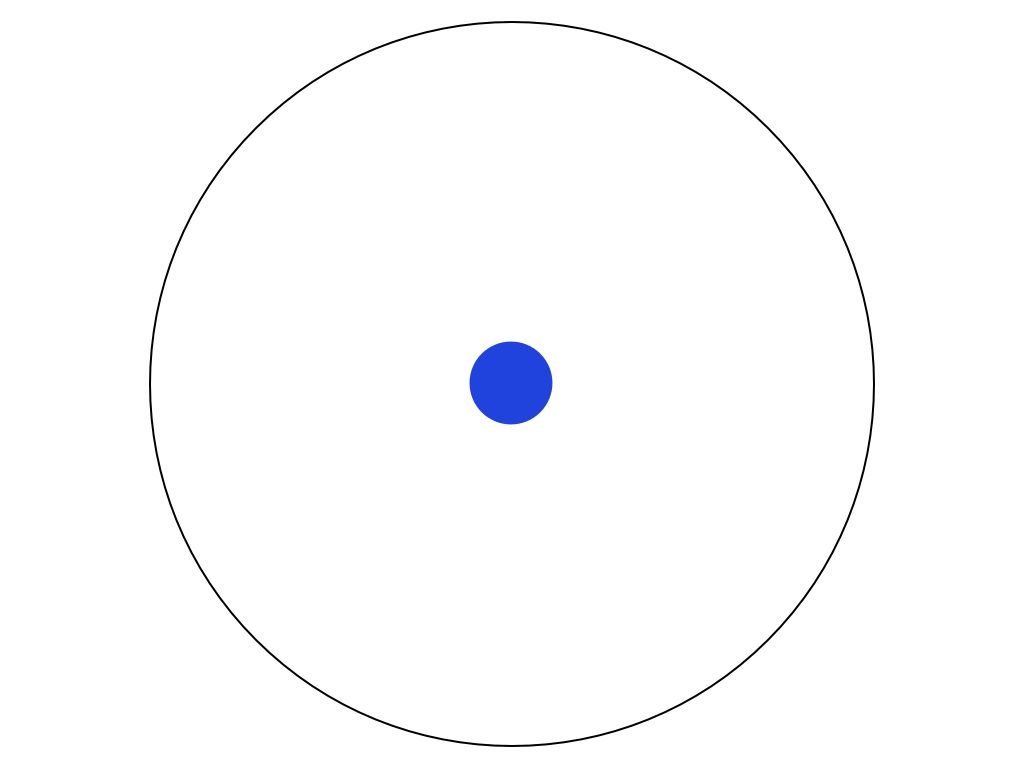
By the time you finish high school, you know a bit more:
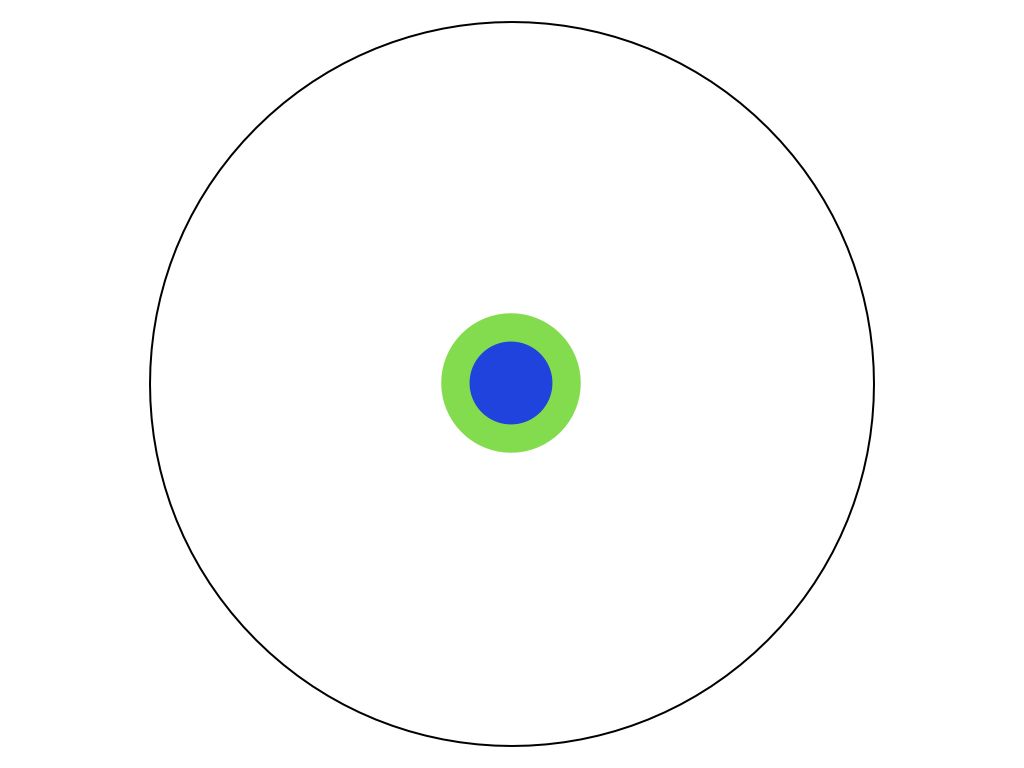
With a bachelor’s degree, you gain a specialty:
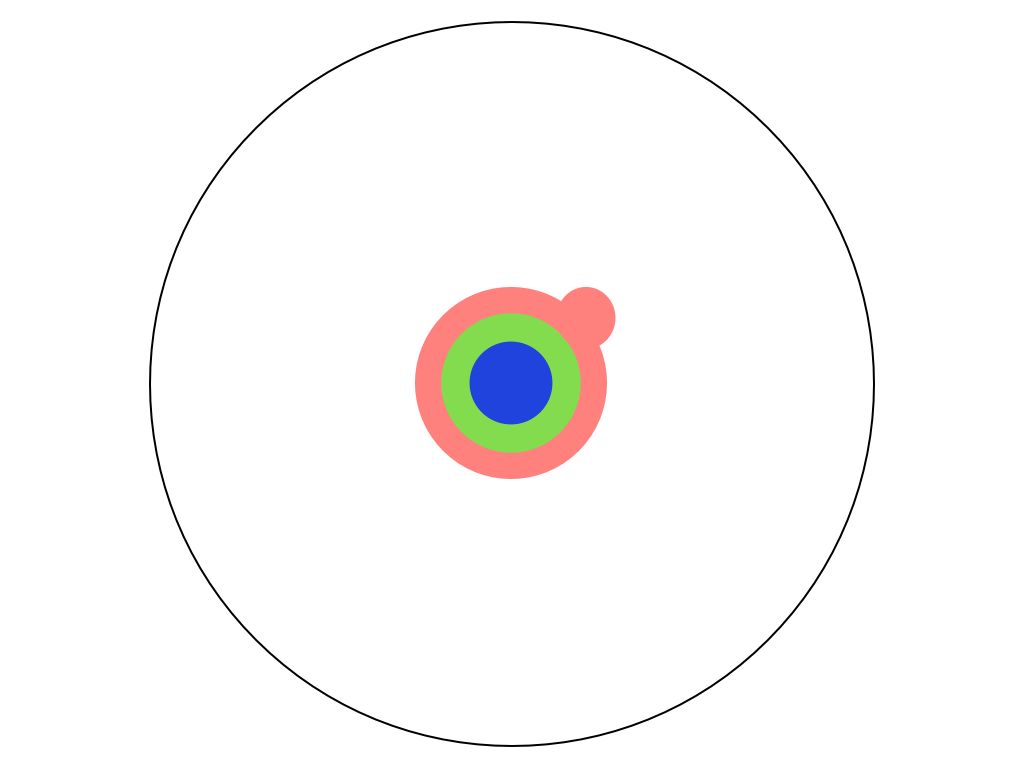
A master’s degree deepens that specialty:
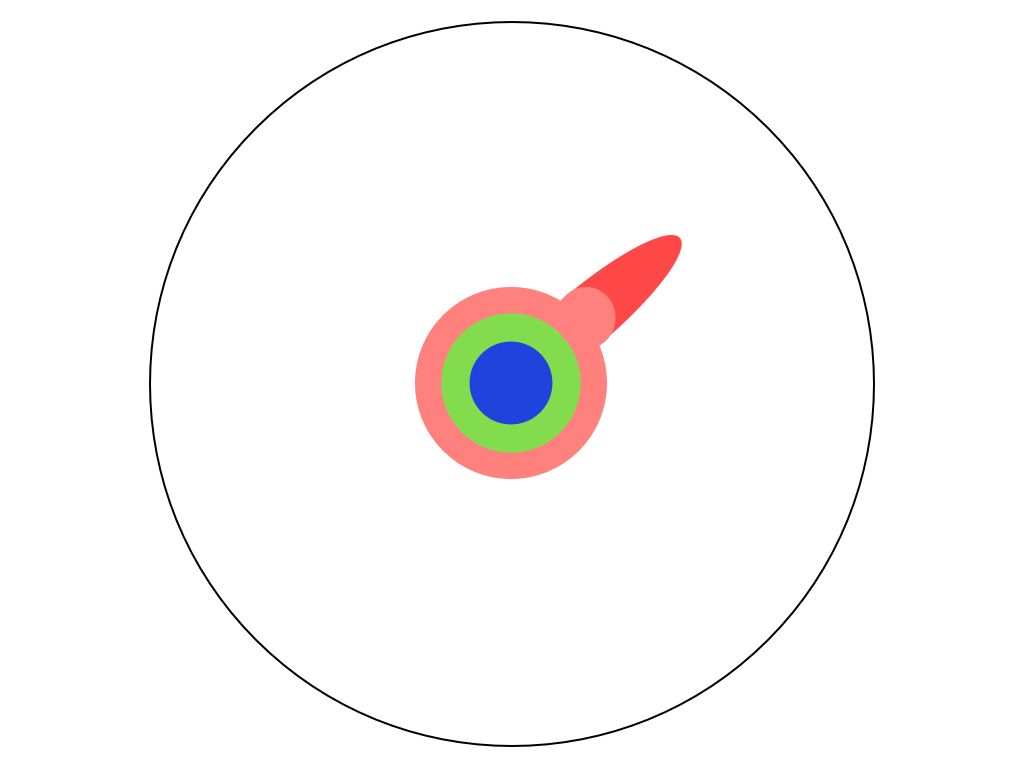
Reading research papers takes you to the edge of human knowledge:
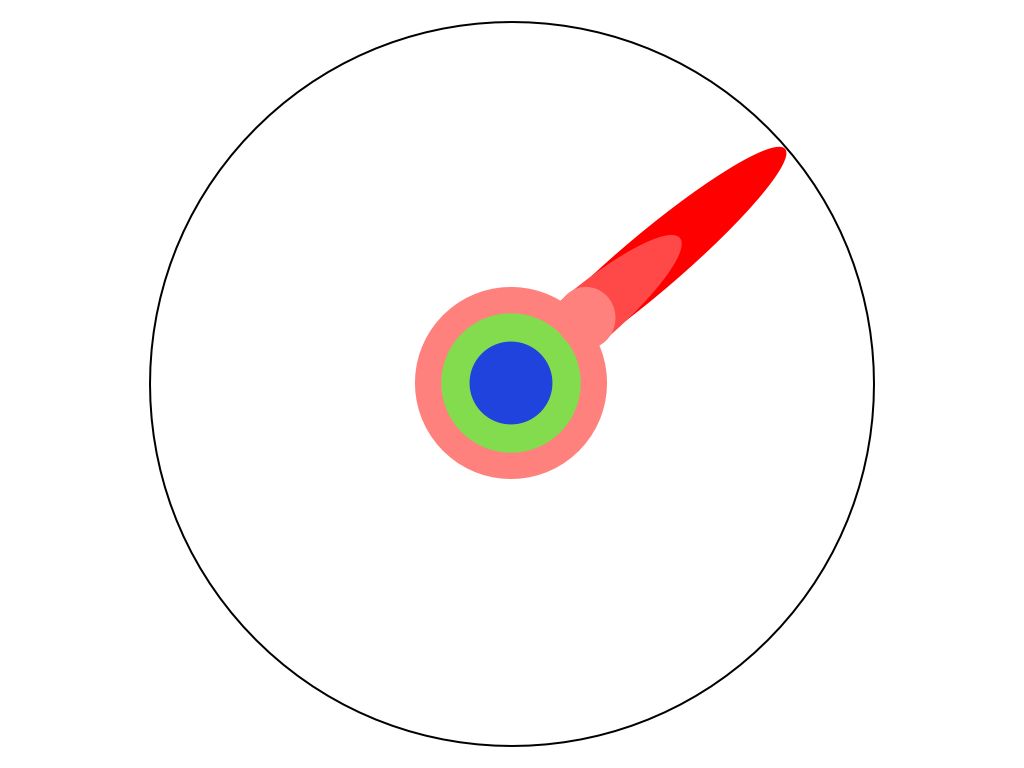
Once you’re at the boundary, you focus:
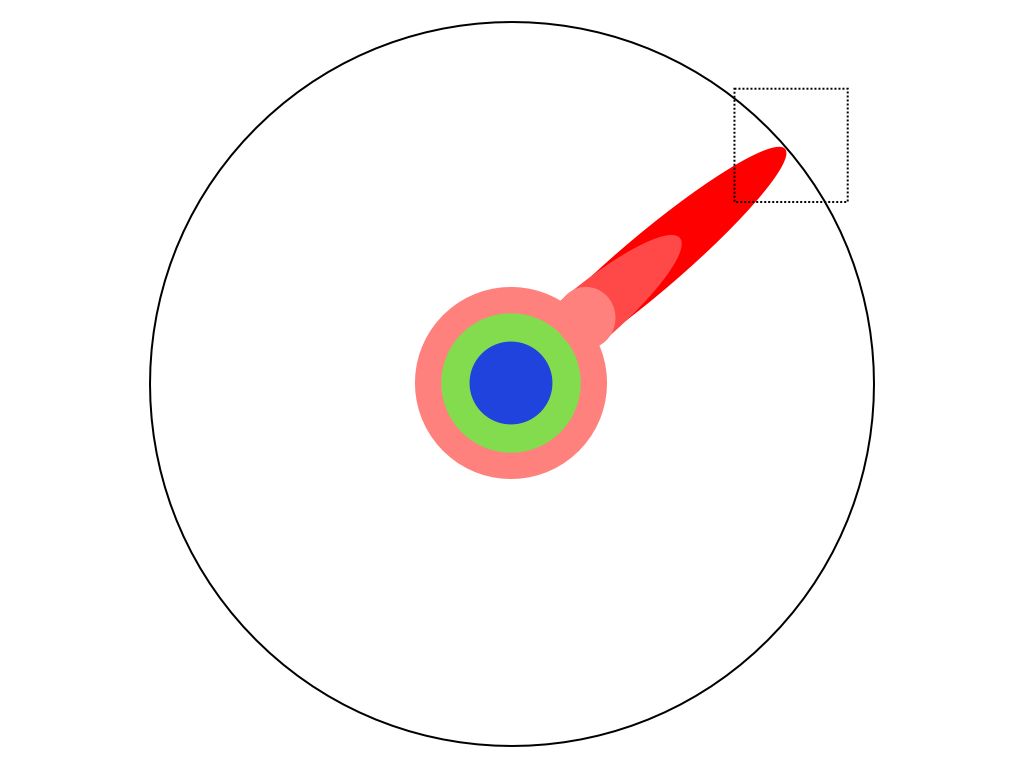
You push at the boundary for a few years:

Until one day, the boundary gives way:

And, that dent you’ve made is called a Ph.D.:
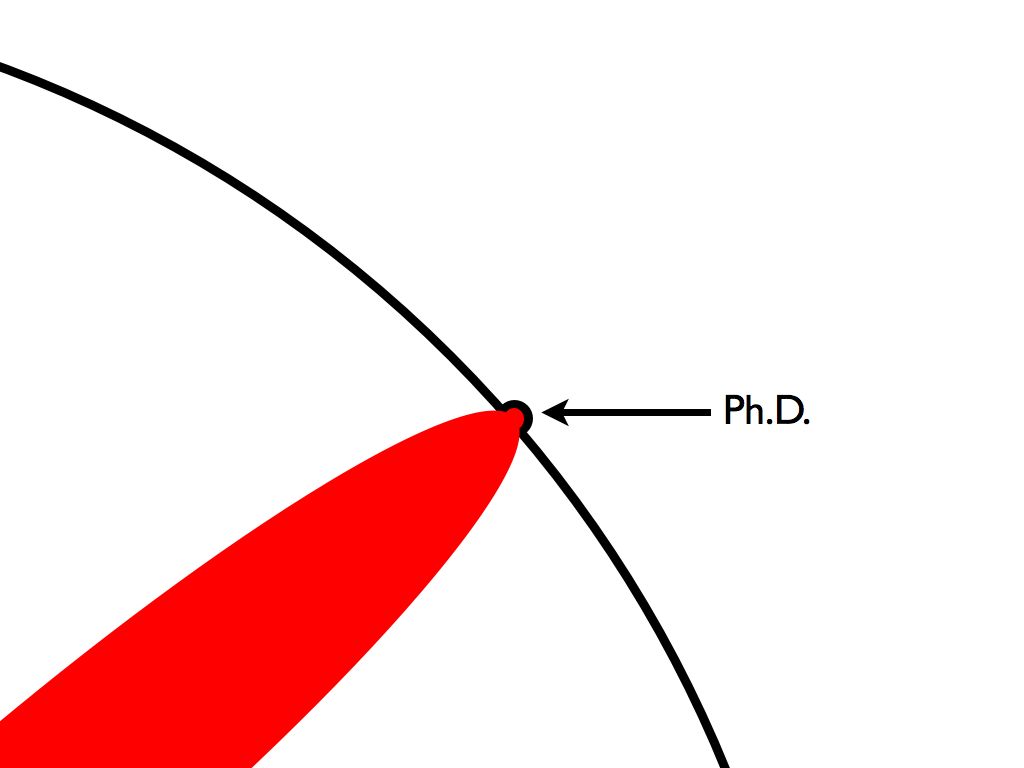
Of course, the world looks different to you now:

So, don’t forget the bigger picture:

Keep pushing.
There’s a bit more below, but I also wrote a follow-up 5 years after the illustrated guide which may be of interest — HOWTO: Get tenure.
Related posts
- HOWTO: Get tenure.
- Recommended reading for grad students.
- What every CS major should know.
- How to get into grad school.
- Advice for thesis proposals.
- Productivity tips for academics.
- Academic job hunt advice.
- Successful Ph.D. students: Perseverance, tenacity and cogency.
- The CRAPL: An open source license for academics.
- The shape of your problem.
If you like these posts, then I recommend the book A PhD Is Not Enough:
Get it in print; fund students; save lives
By request, a print version of The Illustrated Guide to a Ph.D. is on sale.
Click here to preview or buy it.

Any and all proceeds will fund graduate students whose work may impact the discovery, diagnosis or treatment of genetic disorders.
Any and all proceeds will fund graduate students (and postdocs) doing work in biology that may impact treatment of diseases of cellular metabolism.
Update: If you’re interested in being that postdoc, get in touch with me!
It is available at $6.50 thanks to Hewlett-Packard’s high-quality on-demand publishing service, MagCloud.
It’s sixteen pages, saddle-stitch bound and in full color.
It’s a good gift for new students, the recently defended and relatives thereof.
Why biology?
If you zoom in on the boundary of human knowledge in the direction of genetics, there’s something just outside humanity’s reach:

My wife and I chose to start funding these graduate students after we learned that our son has a rare, fatal genetic disorder.
It may be too late for my son, but it’s not too late for other children.
Even one child suffering is one child too many.
The only way to end this kind of suffering is science.
And, the best way to do science is through graduate students.
*Update: When I first wrote this post, my son’s specific disorder was unknown. Thanks to a scientific advance made in genetic diagnostics—specifically exome sequencing—we were able to isolate the mutations in my son’s genome and determine that he is the very first documented case of a new disease: N-glycanase deficiency.
One small dent in the circle of knowledge; one giant leap for my son.
You can read the full story in a new post:Hunting down my son’s killer.*
License: Creative Commons
I receive numerous requests to reproduce this work, and I’m happy to grant them all, subject to three small conditions:
- Please attribute the original work to me (Matt Might) and link back to this page in your reproduction:
ashttp://matt.might.net/articles/phd-school-in-pictures/The Illustrated Guide to a Ph.D. - When you attribute, please also link my name,
Matt Might, to:http://matt.might.net/ - And, don’t forget the “Keep pushing,” at the bottom!
This work is licensed under the Creative Commons Attribution-NonCommercial 2.5 License.
That means you can share, copy, modify and reproduce this work as long as you attribute the original work to me and link back to it as outlined above.
However, you may not sell this work, or use it for commercial purposes. You may only distribute it free of charge. If you’re not sure whether your use is a “commercial purpose,” please send me an email.
If possible, please host the images on your own server instead of linking back to mine.
If you use it in a presentation, I’d love to hear feedback.
Here’s an example attribution that satisfies the legal requirements:
Matt Might, a professor in Computer Science at the University of Utah, created The Illustrated Guide to a Ph.D. to explain what a Ph.D. is to new and aspiring graduate students. [Matt has licensed the guide for sharing with special terms under the Creative Commons license.]
If it helps, here’s the corresponding HTML, which you can modify to suit your site’s needs:
<a href="http://matt.might.net/">Matt Might</a>, a professor in
<a href="http://www.cs.utah.edu/">Computer Science</a>
at the <a href="http://www.utah.edu/">University of Utah</a>, created
<a href="http://matt.might.net/articles/phd-school-in-pictures/">The
Illustrated Guide to a Ph.D.</a> to explain what a Ph.D. is to new and
aspiring graduate students.

[Matt has licensed the guide for sharing with
<a href="http://matt.might.net/articles/phd-school-in-pictures/#license">
special terms under the Creative Commons license</a>.]
And, of course, thank you for sharing!
Resources
Please let me know if you translate this post into another language.
- A slideshow version in PDF.
- French translation (by Sara Mathieu-C.)
- Urdu translation (by Adnan Masood)
- Japanese translation (by Kimikazu Kato)
- UK English “translation” (as interpreted by Gabriel Egan)
- Brazilian Portuguese translation (by Kleber Jacinto)
- Turkish translation (by Y.Ercan Payidar)
- Spanish translation (by Ismael Peña-López)
- Italian translation (by Alessandro Ferrari)
- Indonesian translation (by Robin Malau)
- Greek translation (by Anestis Chatzidiakos)
- Korean translation
- Norwegian translation (by DION)
- Russian translation (by Shemra Rizzo)
- Hungarian translation (by Zoltan Prekopcsak)
- Chinese translation (by Yifeng Yuan)
- Simplified Chinese translation by (Sijia Zhao)
- German translation (by Paul Balzer)
- Persian translation (by Kian Abbasnejadi)
- Czech translation (by Lukas Kalous)
- Slovak translation (by Stano Bustor)
- Serbian Translation (by Lazar Kovacevic)
- Swedish Translation
- Filipino translation (by Andrew Pua)
- Italian translation (by Marco Fotino)
- Arabic translation (by Areeb Alowisheq)
- Vietnamese translation.
- Polish translation.
- Dutch translation.
- Ukranian translation.
- Uzbek translation.
- Hebrew translation (by Regev Elya).
- Belarussian translation.
- Catalan translation by Sebas Mas.
- Finnish translation by Joutsiniemi Anssi.
- Basque Translation by Jesus Romo.
图解博士之路
想象一个包含所有人类知识的圆:
等你小学毕业时,你知道了一点点:
等你高中毕业时,你知道得更多了一些:
拥有学士学位后,你获得了一个专业:
硕士学位加深了你的专业:
阅读研究论文将你带到了人类知识的边缘:
一旦你到达边界,你就会集中精力:
你会在边界上努力推进几年:
直到有一天,边界让步了:
而你造成的那个凹痕就被称为博士学位:
当然,世界在你眼中现在看起来不同了:
所以,不要忘记更大的图景:
继续推动。
下面还有一些内容,但我也在图文指南发布五年后写了一篇后续文章,可能会让你感兴趣——如何:获得终身教职。
相关帖子
- 如何:获得终身教职。
- 推荐给研究生的阅读材料。
- 每个计算机科学专业学生都应该知道的事情。
- 如何进入研究生院。
- 关于论文提案的建议。
- 给学者的生产力提示。
- 学术求职建议。
- 成功的博士生:毅力、韧性和说服力。
- CRAPL:一个面向学者的开源许可证。
- 你的问题的形状。
如果你喜欢这些帖子,那么我推荐这本书 博士学位还不够:
印刷版本;资助学生;拯救生命
应要求,《博士学位图文指南》的印刷版正在出售。
所有收益将用于资助那些其工作可能影响遗传性疾病的发现、诊断或治疗的研究生。
所有收益将用于资助从事生物学工作,可能影响细胞代谢疾病治疗的研究生(和博士后)。
更新:如果你有兴趣成为那名博士后,请与我联系!
得益于惠普的高质量按需出版服务 MagCloud,它的售价为 $6.50。
它有十六页,采用骑马钉装订,全彩色印刷。
这是送给新学生、最近完成答辩的人及其亲属的一份好礼物。
为什么是生物学?
如果你在人类知识的边界朝着遗传学的方向放大,就会发现人类尚未触及的一些东西:
我和我的妻子是在得知我们的儿子患有一种罕见的致命遗传疾病后,决定开始资助这些研究生的。
对我的儿子来说可能太晚了,但对其他孩子来说还不晚。
即使是一个孩子受苦,也嫌太多。
结束这种痛苦的唯一方法是科学。
而进行科学研究的最佳途径是通过研究生。
*更新:当我第一次写这篇文章时,我儿子的具体疾病尚不清楚。多亏了基因诊断领域的一项科学进步——特别是外显子组测序——我们得以分离出我儿子基因组中的突变,并确定他是 N-聚糖酶缺乏症这一新疾病的第一个有记录的病例。
知识圈上的一个小小的凹痕;对我儿子来说是巨大的一步。
你可以在一篇新文章中阅读完整的故事:追捕杀害我儿子的凶手。*
许可:知识共享
我收到了许多复制此作品的请求,我很乐意批准所有这些请求,但需满足三个小条件:
- 请将原始作品归功于我 (Matt Might),并在你的复制品中链接回本页面:
作为http://matt.might.net/articles/phd-school-in-pictures/The Illustrated Guide to a Ph.D. - 在署名时,请也将我的名字
Matt Might链接到:http://matt.might.net/ - 并且,不要忘记底部的“继续推动。”!
本作品根据 知识共享署名-非商业性 2.5 许可授权。
这意味着你可以分享、复制、修改和复制本作品,只要你将原始作品归功于我,并按照上述规定链接回它。
但是,你不得出售本作品,或将其用于商业目的。你只能免费分发它。如果你不确定你的使用是否属于“商业目的”,请给我发送电子邮件。
如果可能,请将图片托管在你自己的服务器上,而不是链接回我的服务器。
如果你在演示文稿中使用它,我很乐意听取反馈。
以下是一个符合法律要求的署名示例:
Matt Might,犹他大学 计算机科学教授,创作了 The Illustrated Guide to a Ph.D.,向新的和有抱负的研究生解释什么是博士学位。[Matt 已根据 知识共享许可的特殊条款授权分享本指南。]
如果有所帮助,以下是相应的 HTML 代码,你可以根据你的网站需求进行修改:
<a href="http://matt.might.net/">Matt Might</a>, a professor in
<a href="http://www.cs.utah.edu/">Computer Science</a>
at the <a href="http://www.utah.edu/">University of Utah</a>, created
<a href="http://matt.might.net/articles/phd-school-in-pictures/">The
Illustrated Guide to a Ph.D.</a> to explain what a Ph.D. is to new and
aspiring graduate students.

[Matt has licensed the guide for sharing with
<a href="http://matt.might.net/articles/phd-school-in-pictures/#license">
special terms under the Creative Commons license</a>.]
当然,感谢你的分享!
资源
如果你将此帖子翻译成其他语言,请告诉我。
- PDF 格式的幻灯片版本。
- 法语翻译(由 Sara Mathieu-C. 完成)
- 乌尔都语翻译(由 Adnan Masood 完成)
- 日语翻译(由 Kimikazu Kato 完成)
- 英式英语“翻译”(由 Gabriel Egan 演绎)
- 巴西葡萄牙语翻译(由 Kleber Jacinto 完成)
- 土耳其语翻译(由 Y.Ercan Payidar 完成)
- 西班牙语翻译(由 Ismael Peña-López 完成)
- 意大利语翻译(由 Alessandro Ferrari 完成)
- 印度尼西亚语翻译(由 Robin Malau 完成)
- 希腊语翻译(由 Anestis Chatzidiakos 完成)
- 韩语翻译
- 挪威语翻译(由 DION 完成)
- 俄语翻译(由 Shemra Rizzo 完成)
- 匈牙利语翻译(由 Zoltan Prekopcsak 完成)
- 中文翻译(由 Yifeng Yuan 完成)
- 简体中文翻译(由 Sijia Zhao 完成)
- 德语翻译(由 Paul Balzer 完成)
- 波斯语翻译(由 Kian Abbasnejadi 完成)
- 捷克语翻译(由 Lukas Kalous 完成)
- 斯洛伐克语翻译(由 Stano Bustor 完成)
- 塞尔维亚语翻译(由 Lazar Kovacevic 完成)
- 瑞典语翻译
- 菲律宾语翻译(由 Andrew Pua 完成)
- 意大利语翻译(由 Marco Fotino 完成)
- 阿拉伯语翻译(由 Areeb Alowisheq 完成)
- 越南语翻译。
- 波兰语翻译。
- 荷兰语翻译。
- 乌克兰语翻译。
- 乌兹别克语翻译。
- 希伯来语翻译(由 Regev Elya 完成)。
- 白俄罗斯语翻译。
- 加泰罗尼亚语翻译(由 Sebas Mas 完成)。
- 芬兰语翻译(由 Joutsiniemi Anssi 完成)。
- 巴斯克语翻译(由 Jesus Romo 完成)。